Hostfully
Introduction to Hostfully
Hostfully is a leading vacation rental management platform that helps property managers streamline their operations, automate guest communication, and optimize bookings. As a B2B SaaS platform, Hostfully primarily serves vacation rental businesses looking to scale efficiently.
In the 12 months leading up to our engagement, Hostfully’s organic traffic had been in continuous decline. Despite no direct impact on demo requests initially, their leadership was deeply concerned about the loss of visibility in search.
Hostfully partnered with me to reverse this traffic decline and drive meaningful organic growth, prioritizing demo requests as the core KPI. The engagement has now run for 19 months, and this case study covers the full arc — from the initial diagnosis through the results as of January 2026.
The Challenge: Stopping a 12-Month Traffic Decline & Driving Sustainable Growth
Key Problems Identified
Hostfully’s marketing team had hypothesized several reasons for the traffic drop, including:
Over-reliance on low-competition, ToFu content
The previous content strategy focused on low-intent keywords with little buyer alignment, which resulted in rankings but didn’t drive conversions.
Google’s algorithm updates deprioritized such content, particularly those loosely associated with Airbnb.
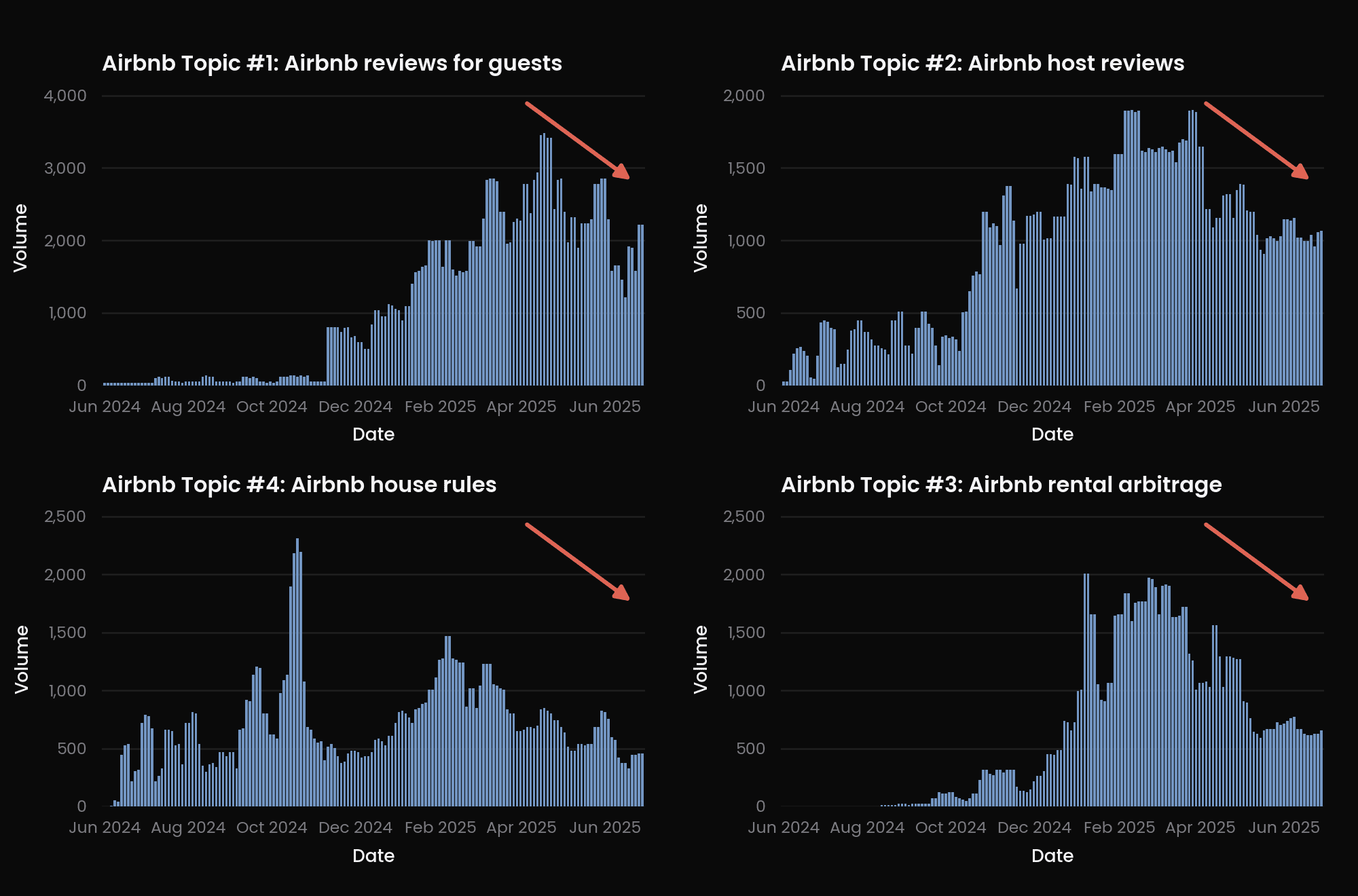
Shrinking search demand for key topic clusters
Several pages that previously drove traffic were losing relevance as fewer people searched for those topics.
Airbnb-related keywords, which once performed well, were no longer viable sources of organic growth.
Algorithmic Vulnerability
Some competitors copied Hostfully’s content and likely used AI-generated rewrites, diluting the uniqueness of their pages.
Google’s updates reassessed these factors, resulting in ranking declines.
Technical SEO Issues Hindering Crawl Efficiency
Crawl budget was being wasted on irrelevant subdomains, preventing proper indexing of key pages.
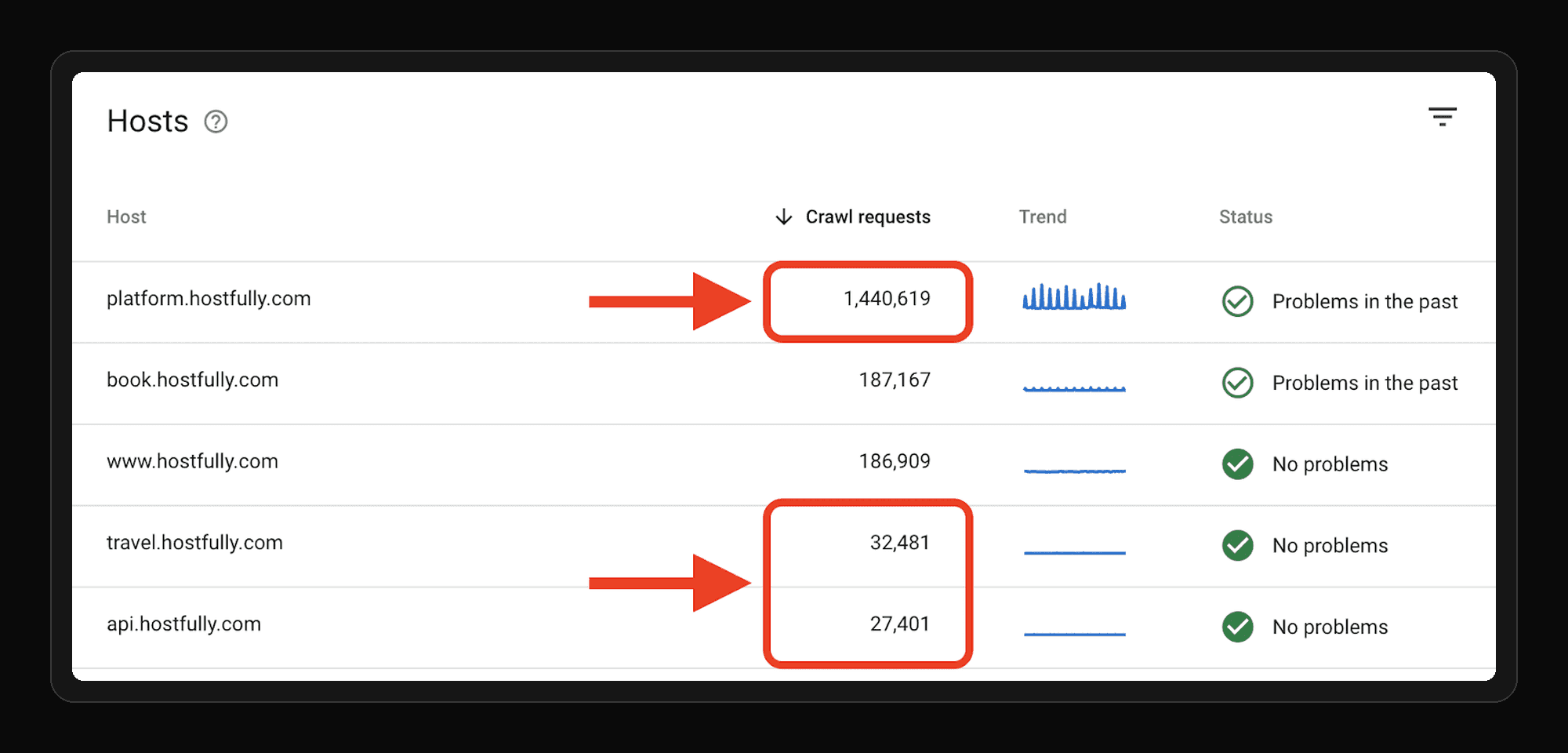
Crawl requests were dominated by subdomains unrelated to organic acquisition.
Sitemap misconfigurations and misimplemented canonical tags were creating further indexing issues.

Submitted sitemaps showing fetch failures and error states in Google Search Console.
A shifting search landscape
Partway through the engagement, Google AI Overviews expanded across informational queries and AI assistants began absorbing top-of-funnel research that had previously landed on vacation rental blogs.
Across B2B SaaS, sites with heavy ToFU footprints saw click-through rates fall even where rankings held. This made session growth an unreliable measure of SEO value and reinforced demo requests as the metric that mattered.
Business Goals
Hostfully had two clear objectives for us:
Stop the decline in organic traffic by optimizing and revamping existing content based on expected commercial value.
Drive more demo requests by identifying and focusing on high-intent, conversion-driven SEO opportunities.
Their north star metric was increasing demo requests, but stopping the traffic decline (and ideally reversing it) was also a major priority. As the engagement continued, the goal sharpened further: keep organic demo generation compounding even as AI search compressed the click volume available at the top of the funnel.
The Strategy: A Focused Approach to Organic Growth
To meet both objectives, we shifted the SEO focus towards buyer-aligned topic clusters, leaning heavily into mid and bottom-of-funnel (MOFU & BOFU) content while deprioritizing broad ToFU topics. Four workstreams ran across the engagement.
Step 1: Technical SEO Audit & Fixes
We conducted separate technical SEO audits for desktop and mobile to uncover high-impact issues, prioritizing only high-leverage fixes that could directly impact growth. As the site grew, these audits were re-run on a cadence to catch regressions rather than treated as a one-time cleanup.
Key fixes included:
Resolving crawl budget waste by de-indexing irrelevant subdomains.

75% of site crawls were being consumed by a single unnecessary subdomain.
Fixing sitemap misconfigurations to ensure key pages were discoverable.
Correcting canonical tag errors that were preventing Google from ranking the right pages.
Step 2: Deep Content & Conversion Audit
We analyzed traffic, links, and conversion data together to determine which content needed updates and which pages should be left alone. Layering conversion data on top of the traffic analysis meant pages were ranked by their contribution to demo requests, not by session count.
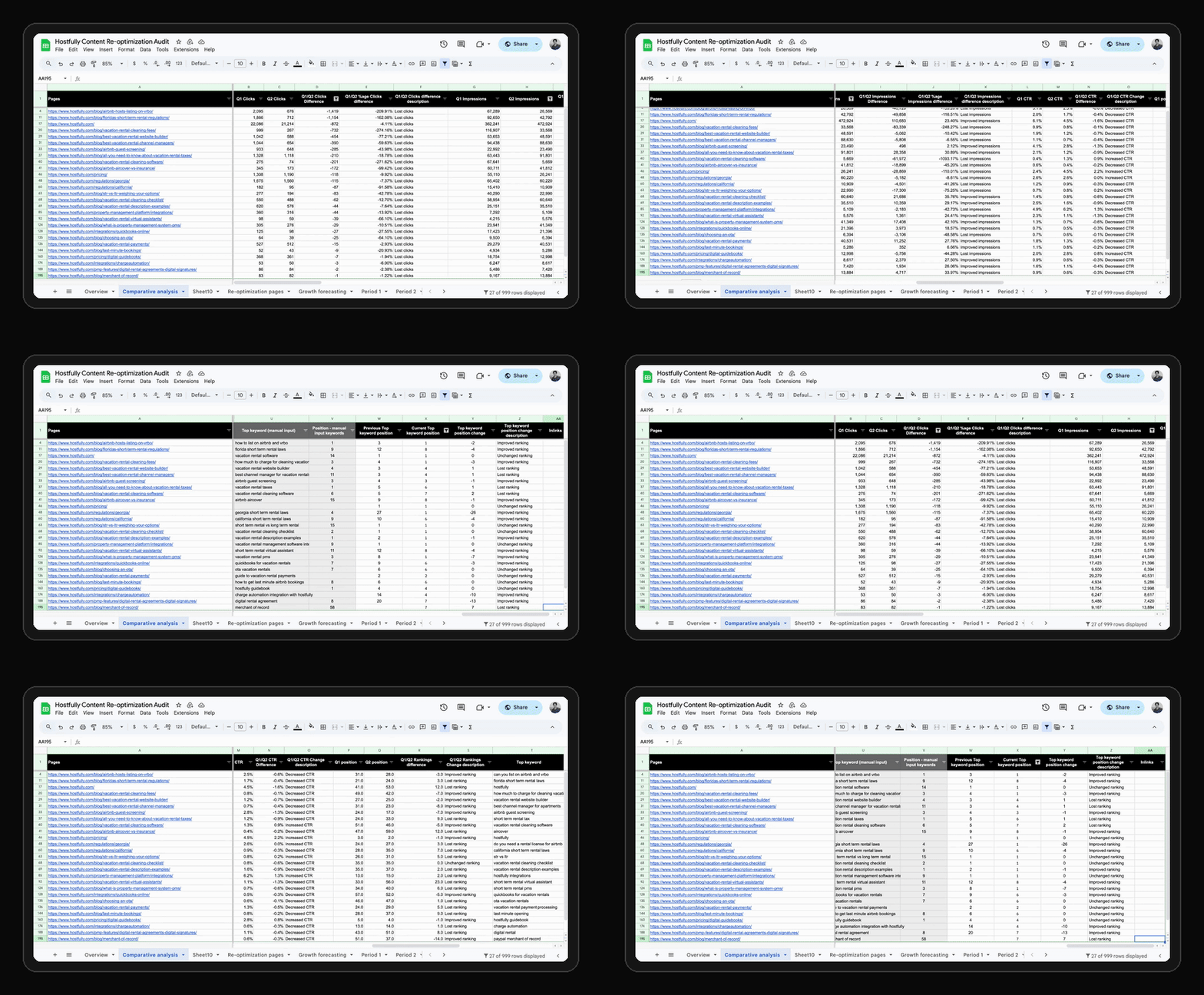
Page-level re-optimization audit comparing click and impression movement period over period.
Key actions:
Prioritized content cohorts that made commercial sense, aligned with demo growth.
Identified pages with declining traffic but high conversion potential and refreshed them with better intent-matching content.
Discovered that Airbnb-related keyword declines were largely due to shrinking search demand, not just content decay.
Step 3: Content Updates & Targeting High-Intent Searchers
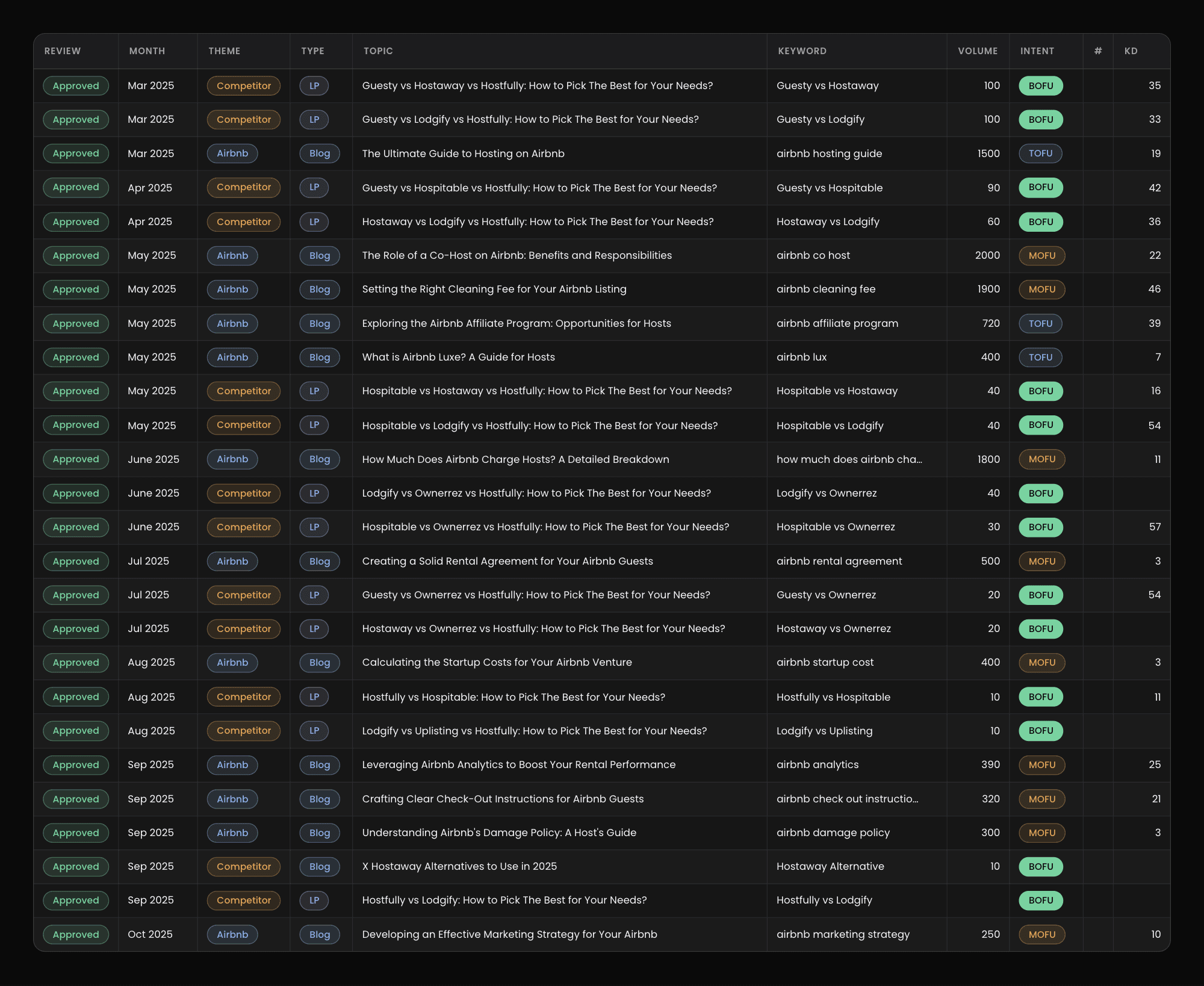
We worked with the content team to update key pages, aligning them more closely with search intent and improving E-E-A-T signals. Every new brief carried a demo-generation rationale rather than just a keyword target, and ToFU topics were maintained only where they fed an existing MOFU or BOFU cluster.
Net-new content research focused on two audiences:
Brand-aware searchers — users already aware of Hostfully and actively comparing it to competitors.
Solution-aware searchers — people looking for vacation rental management solutions but not yet aware of Hostfully.
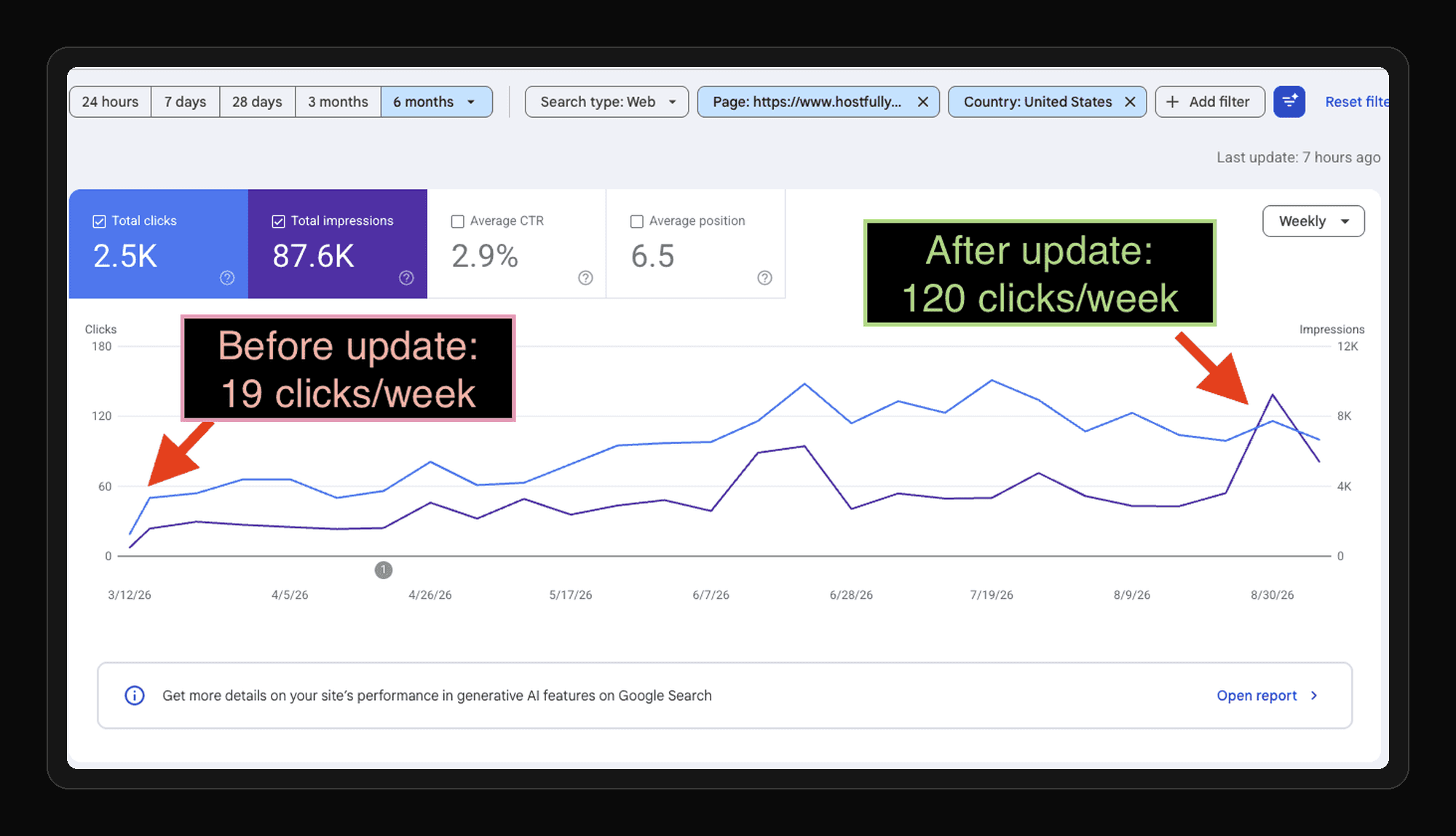
Step 4: Expanding Commercial Content & Topical Authority
With a clearer focus on mid- and bottom-funnel content, we scaled the footprint that was proving out:
Expanded competitor comparison pages to capture decision-stage buyers evaluating alternatives.
Built commercial landing pages covering transactional and category-level demand.
Added supporting MOFU clusters to nurture users down the funnel and strengthen topical authority around vacation rental management software.

The Results: Significant Growth in Organic Performance
Measured from the July 2024 baseline through January 2026, the strategy stopped the 12-month traffic decline and produced growth that compounded month over month rather than spiking and fading:
186% increase in demo requests from organic search — from 43 demos in July 2024 to 123 in January 2026, the highest month on record.
2.9X improvement in organic search conversion rate — from 0.12% to 0.35% of organic sessions converting into demo requests.
Organic traffic held stable — 36,201 sessions in July 2024 versus 35,458 in January 2026, holding flat through a period when AI search platforms and Google AI Overviews were driving broad declines across the category.
Demo volume grew 33% year over year — 1,047 demos in the trailing 12 months versus 785 in the first 12 months of the engagement.
Search Traffic vs Demo Requests
The defining pattern of this engagement is the decoupling of traffic and demos. Sessions stayed broadly flat while demo requests climbed steadily, which means the gains came from better buyer alignment rather than more clicks — the difference between an SEO program that survived 2025 and one that didn’t.
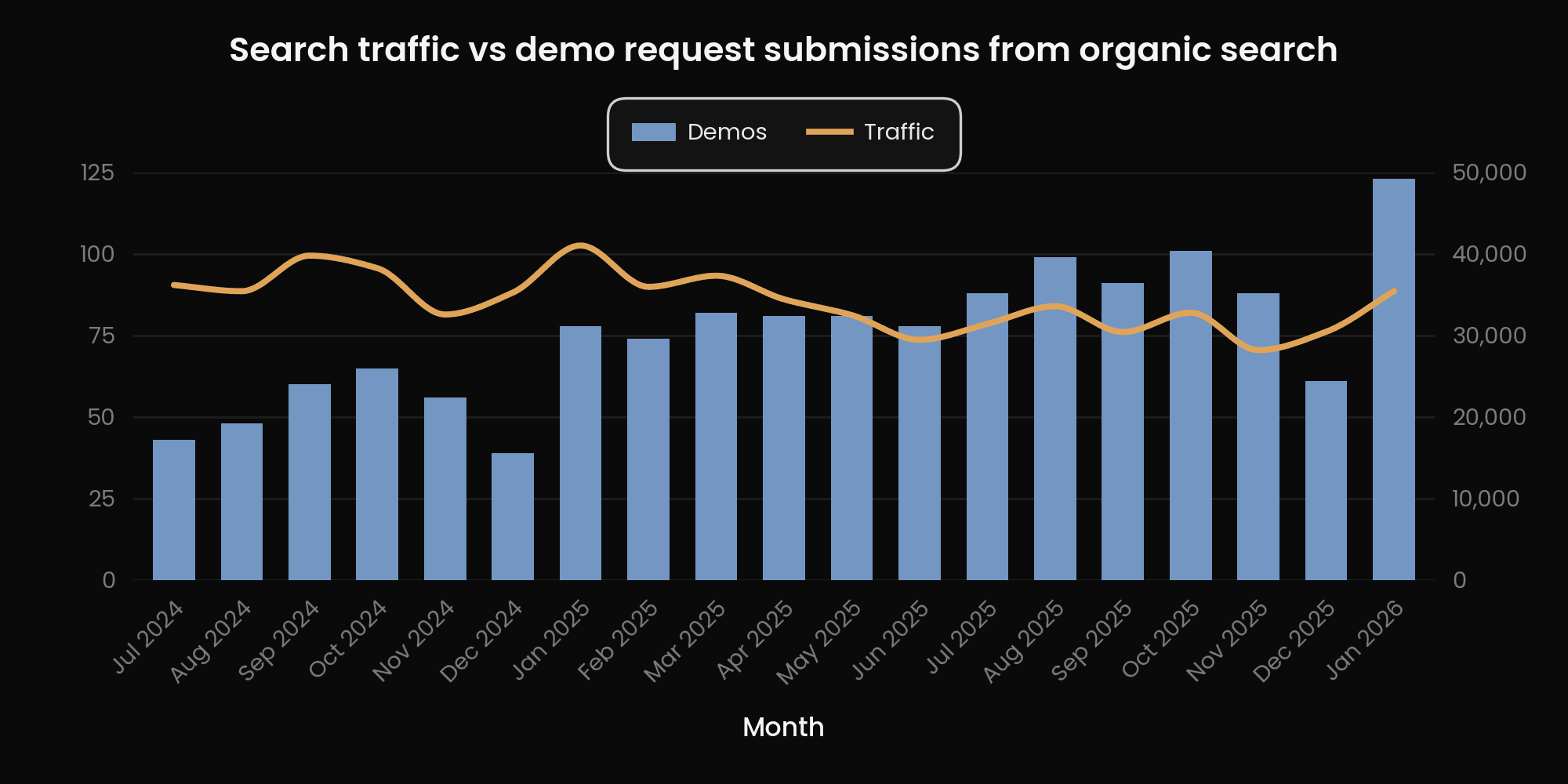
Demo requests climbed consistently while organic sessions remained flat across the 19-month period.
Conversion Rate Growth
Conversion rate improved in 16 of the 19 months tracked. The two declines both landed in December — each a 36% drop, and each followed by a 73% rebound in January. The pattern repeated identically in both years, identifying it as vacation rental buying seasonality rather than content or ranking decay.
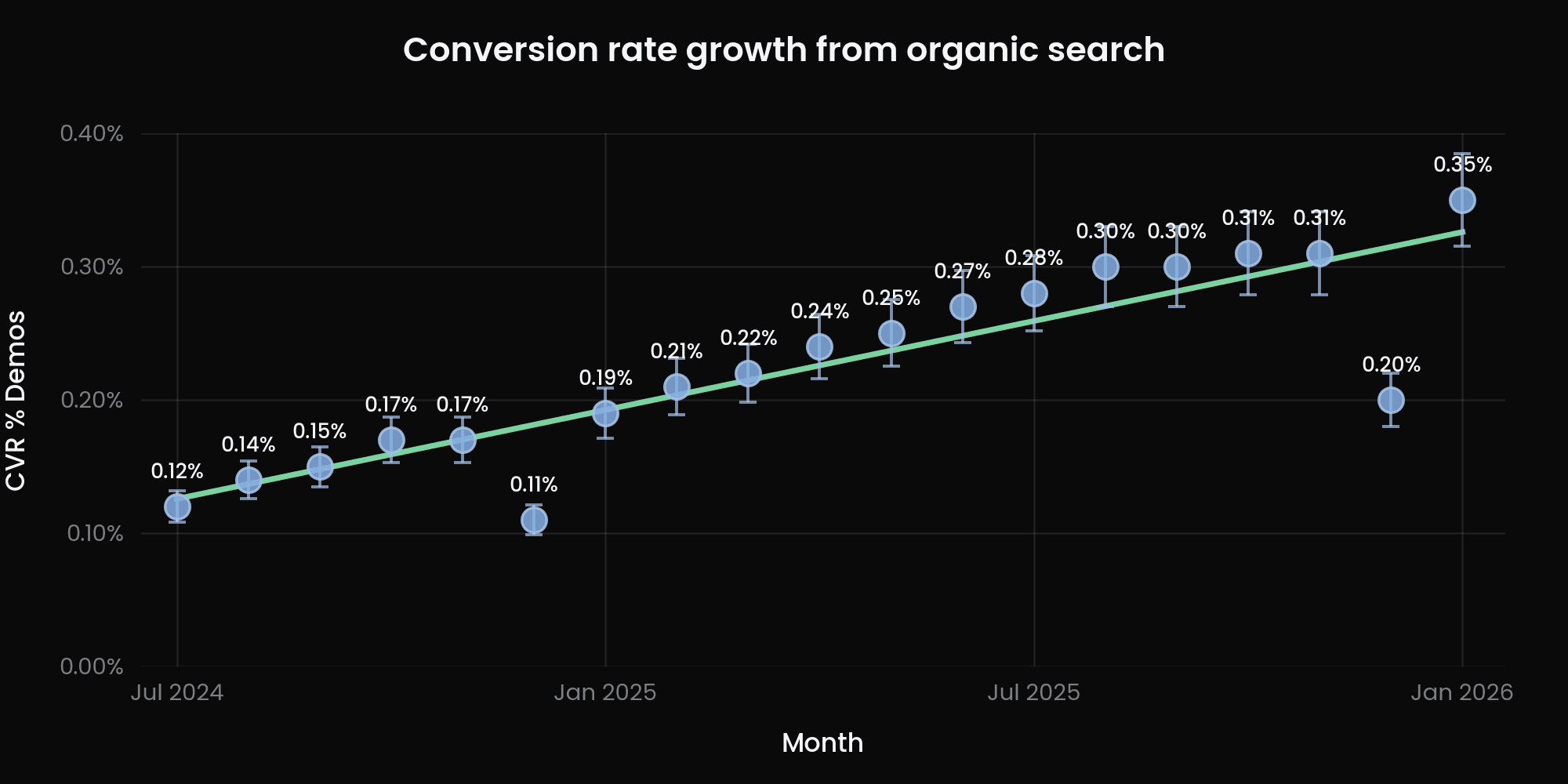
Organic conversion rate climbed from 0.12% to 0.35%, with a clear trend line through seasonal December dips.
What Hostfully said about the engagement
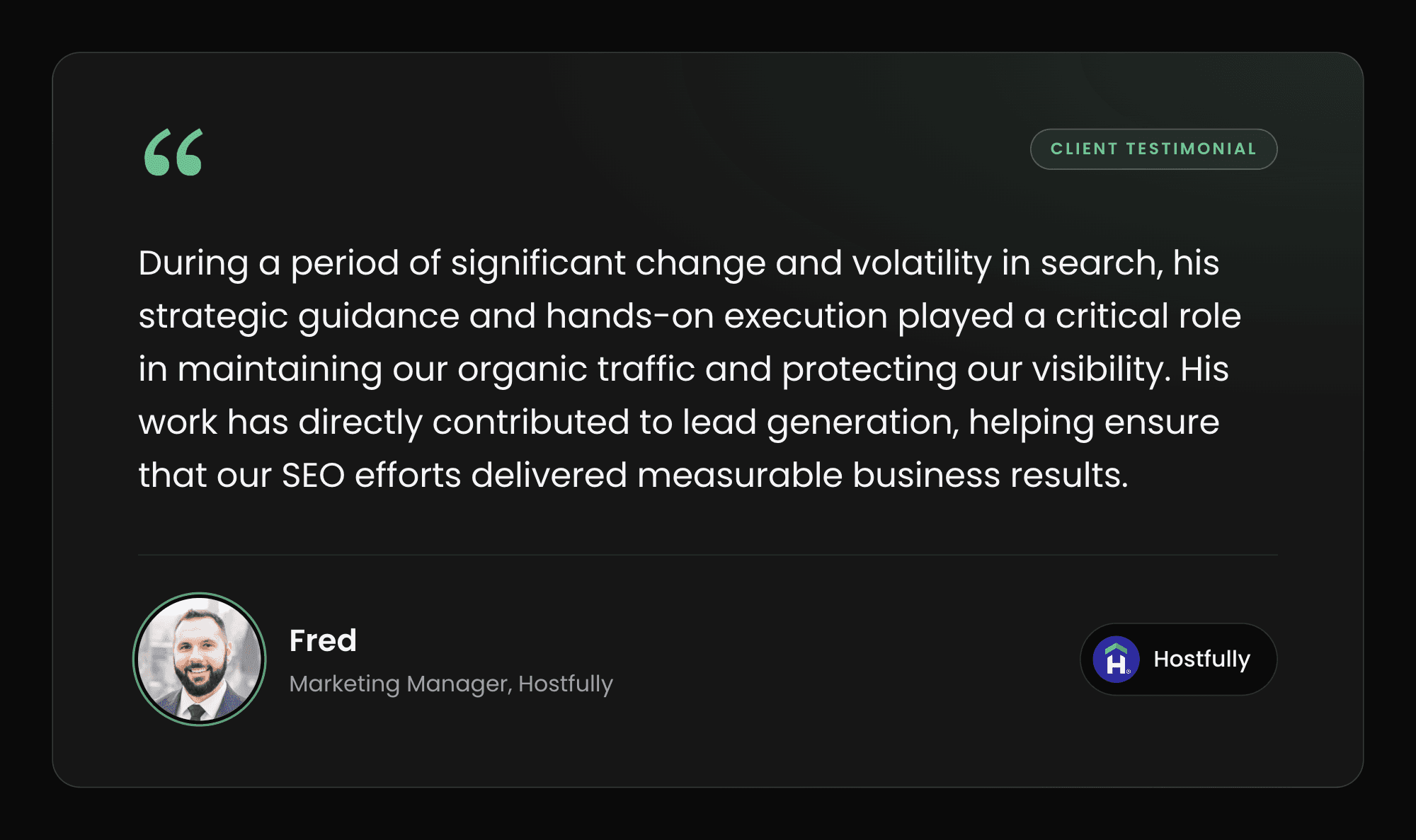
Here’s how Fred, Marketing Manager at Hostfully, describes the impact of the work:
Conclusion: A Scalable Growth Engine for Hostfully
By shifting SEO efforts towards conversion-driven topics, fixing technical inefficiencies, and focusing on mid-to-bottom-funnel opportunities, we helped Hostfully build a resilient, scalable organic growth engine.
Judged on sessions alone, 19 months of work would read as a flat result. Judged on the business outcome, the same amount of search traffic now produces nearly three times the demo volume. That gap is the whole point: the move down the funnel happened ahead of the AI Overviews expansion, which insulated Hostfully from the click compression that hit ToFU-heavy competitors hardest.
Hostfully now has a more predictable, commercially aligned SEO strategy, and we continue to optimize and expand their organic footprint for sustained growth.