
ColdIQ
Introduction to ColdIQ
ColdIQ is a B2B outbound and lead generation agency that helps companies scale their pipeline through cold outreach, automation, and sales systems. Operating in a highly competitive space, ColdIQ combines service delivery with a growing suite of tools and resources designed to support modern outbound teams.
While the company had already achieved strong traction through outbound and paid acquisition, reaching ~$2.5M in ARR, they had started seeing early signals of organic growth from a small set of SEO efforts. Recognizing the long-term potential of inbound, ColdIQ partnered with us to build a structured organic growth engine that could compound over time and support their next stage of revenue growth.
The Challenge: Building an Inbound Engine in a Saturated Market
Key Problems Identified
ColdIQ’s growth was heavily reliant on outbound and paid channels, which, while effective, lacked compounding leverage. The team wanted to establish organic search as a scalable acquisition channel but faced several structural challenges:
High competition in core commercial keywords
Keywords like “sales prospecting software” and related terms were dominated by established players with significantly stronger domain authority.
ColdIQ lacked the topical depth and backlink profile to compete directly in these high-volume spaces.
Limited topical authority in emerging categories
While ColdIQ had strong expertise in outbound, their presence in emerging areas like AI-driven sales automation was still nascent.
This created both a challenge and an opportunity to define authority early.
Fragmented content and weak internal link structure
Existing content efforts were not systematically aligned with commercial goals.
Internal linking was not effectively distributing authority toward high-converting pages.
Underutilized programmatic SEO opportunity
ColdIQ had begun building a directory of tools and resources, but it lacked a structured strategy to scale programmatic SEO effectively.
There was a risk of low-quality page expansion (similar to broader industry failures) without proper control and prioritization.
No structured approach to AI search visibility
With the rise of platforms like ChatGPT and Perplexity, ColdIQ had minimal presence in LLM-driven discovery.
There was no system to influence or track brand visibility across these channels.
Business Goals
ColdIQ had three clear objectives:
Build a scalable inbound engine through organic search (Google + AI search platforms).
Drive qualified pipeline growth, not just traffic, focusing on form submissions and booked meetings.
Establish authority in AI-driven outbound and automation topics, positioning ColdIQ ahead of competitors in emerging categories.
The Strategy: A Dual-Channel Organic Growth Engine (Google + AI Search)
Our strategy focused on building a holistic organic growth system across two core channels:
Traditional search (Google/Bing)
AI search platforms (ChatGPT, Perplexity, Gemini, etc.)
Rather than relying on generic SEO best practices, we prioritized high-leverage actions directly tied to traffic, rankings, and conversions.
Step 1: Technical SEO & Foundational Cleanup
We started by fixing foundational issues to ensure the site could scale efficiently:
Resolved crawl and indexation issues
Cleaned up sitemap inconsistencies
Improved site structure to support programmatic expansion
Ensured key commercial and programmatic pages were discoverable
This created a stable base for both content expansion and ranking improvements.

Prioritized technical issue log with owners, priority levels, and recommended actions.
Step 2: Internal Linking & Website Architecture Overhaul
We redesigned the overall website hierarchy to form a new architecture that’s better optimized for search as well as users.
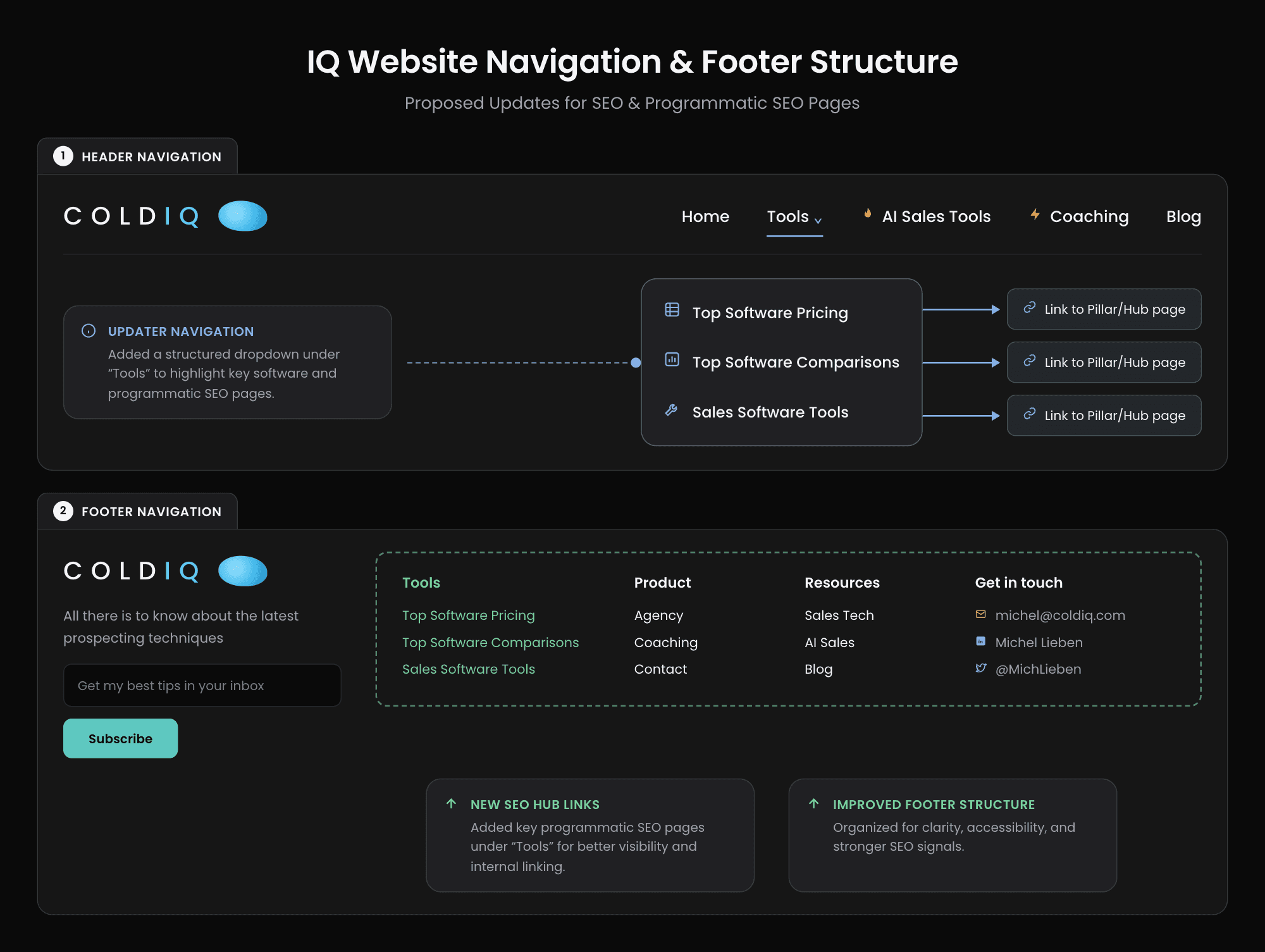
Proposed header and footer navigation updates to surface key SEO and programmatic pages.
In addition, we worked on a revised internal linking structure to better distribute authority across the site:
Built a structured architecture connecting blog, landing pages, and programmatic assets
Directed link equity toward high-intent commercial pages
Strengthened relationships between informational and transactional content
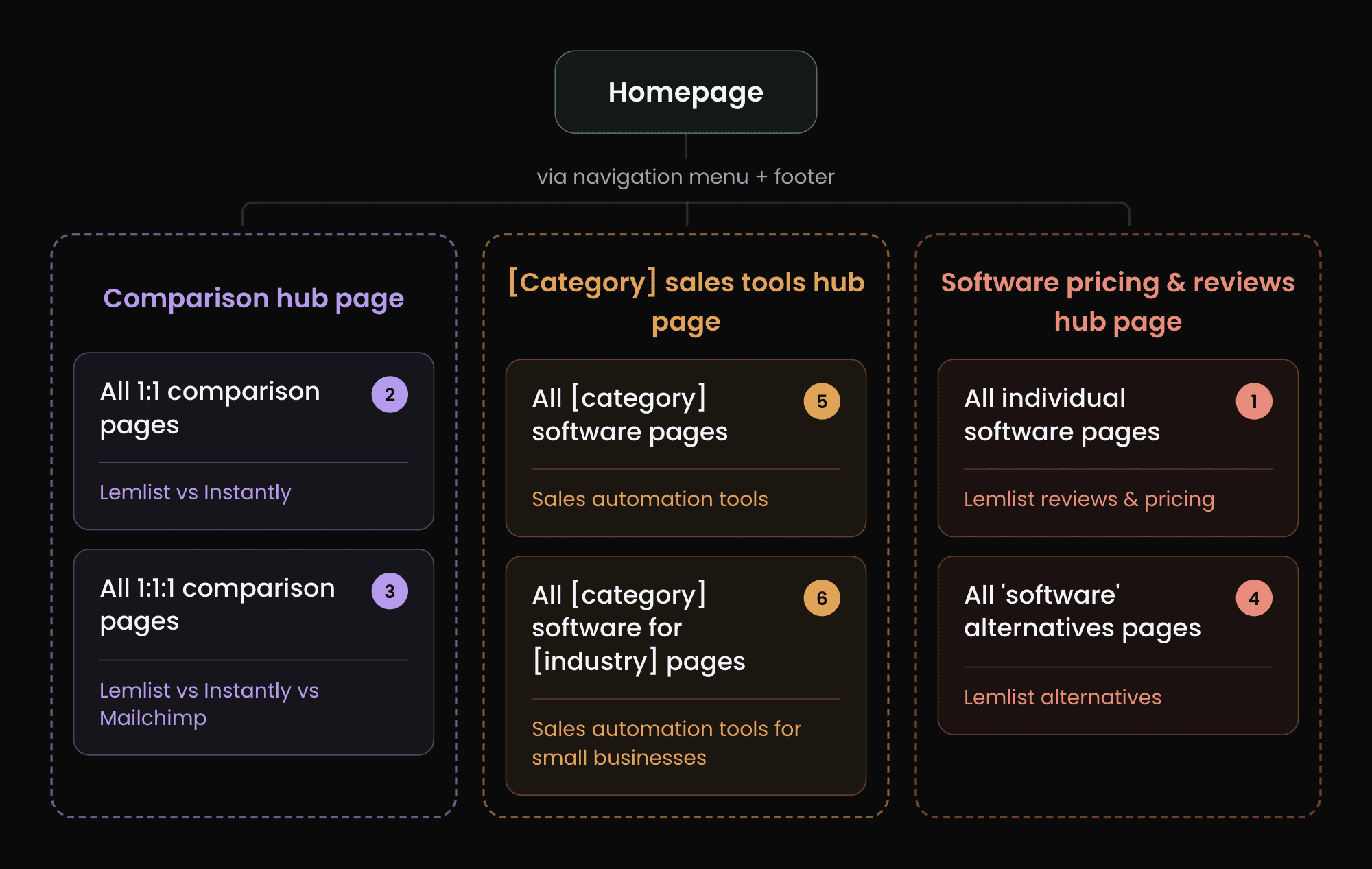
Hub-and-spoke architecture connecting comparison, category, and software pages.
This significantly improved the ranking potential of key pages without relying solely on backlinks.
Step 3: Content Strategy — Optimization + Net-New Creation
We built a two-pronged content system to dominate the most relevant commercial keywords and increase visibility for existing pages.
A. Existing Content Optimization
We identified two high-impact opportunity buckets. The first was pages already ranking in higher position brackets (5–10) that could still be improved.
1. Low-hanging ranking improvements
Optimized title tags, H1s, and meta descriptions
Improved internal linking from other high-traffic pages
Increased CTR and pushed pages into top positions
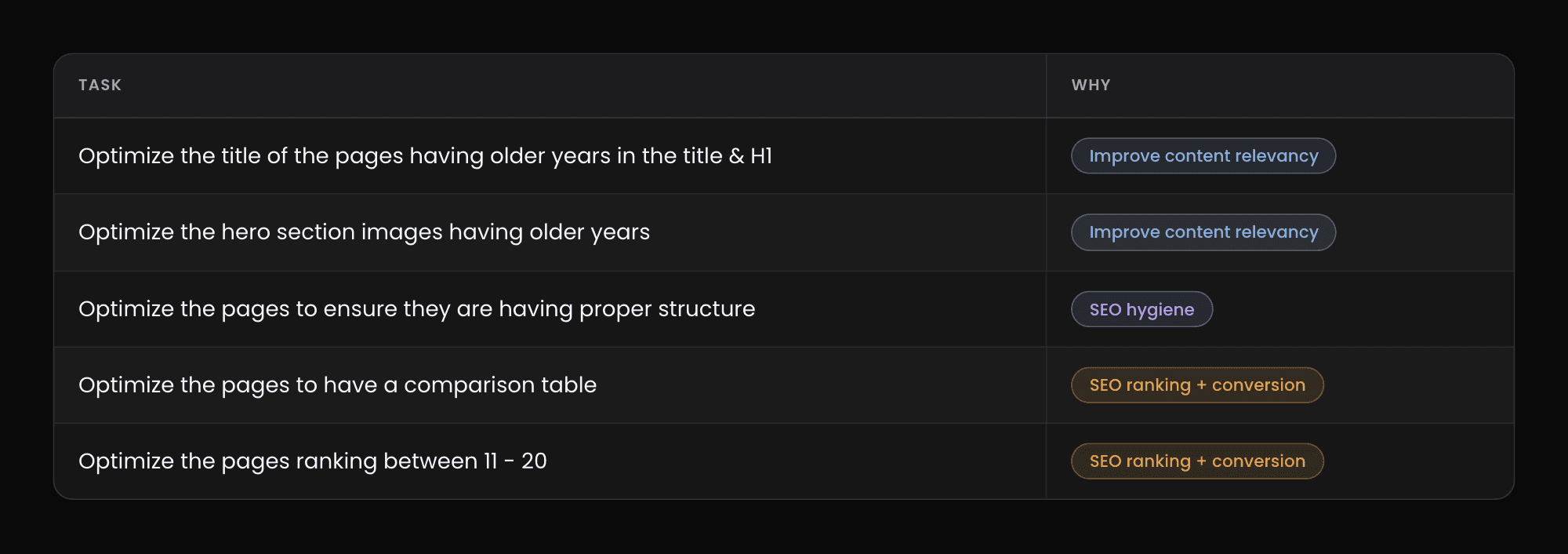
Optimization task list mapped to the ranking or conversion rationale behind each change.
The other bucket focused on high-conversion and high-traffic pages for maximum gains.
2. Conversion rate optimization (CRO)
Improved:
Hero sections
In-content CTAs
Comparison tables and structured content
Introduced wireframe-driven improvements to increase conversions
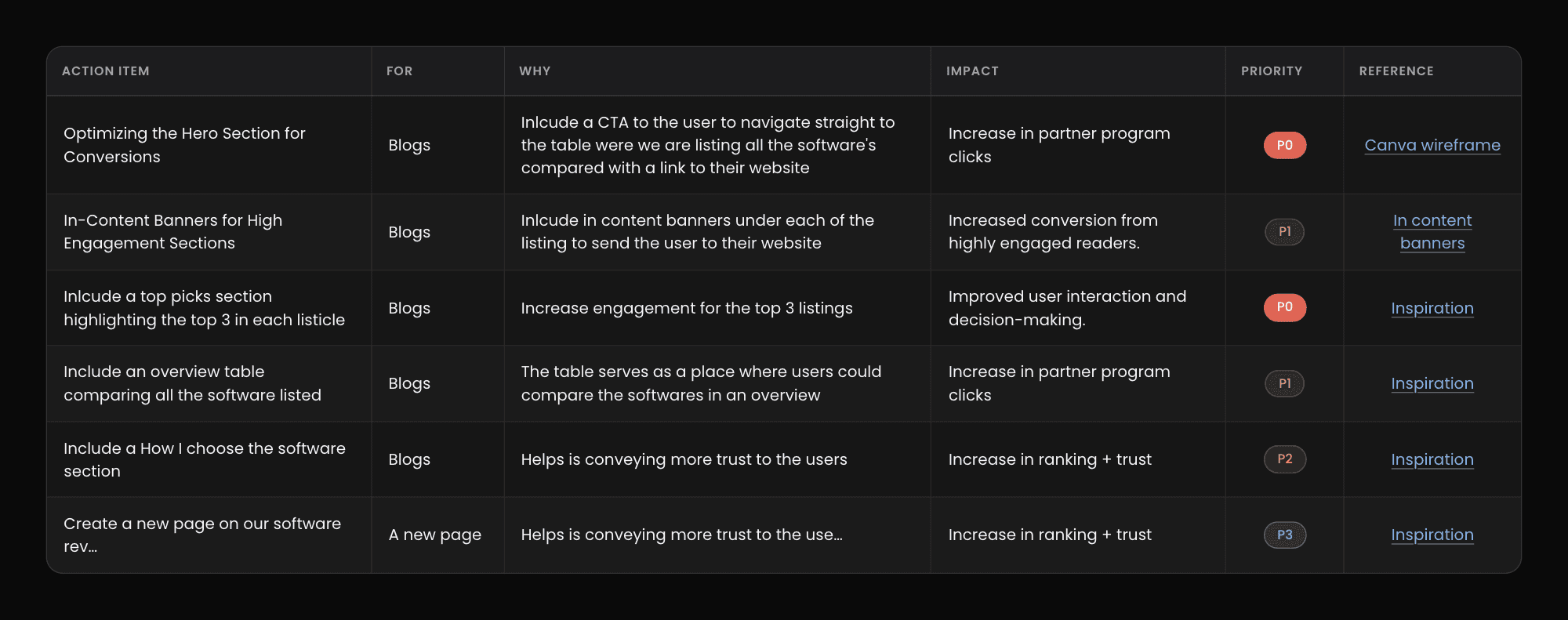
CRO action items prioritized by expected impact, with reference wireframes attached.
B. Net-New Content Creation
Apart from existing content, ColdIQ had a tremendous opportunity to create net-new content. Our focus turned towards developing a content roadmap focused on mid and bottom-of-funnel intent:
Pain-point driven blog content based on real buyer problems
Commercial landing pages targeting transactional queries
AI-focused content to capture emerging demand
Additionally, we:
Launched AI-focused landing pages (13 pages) aligned with service offerings
Built structured content around emerging AI outbound use cases
Ensured every page had a clear path to conversion
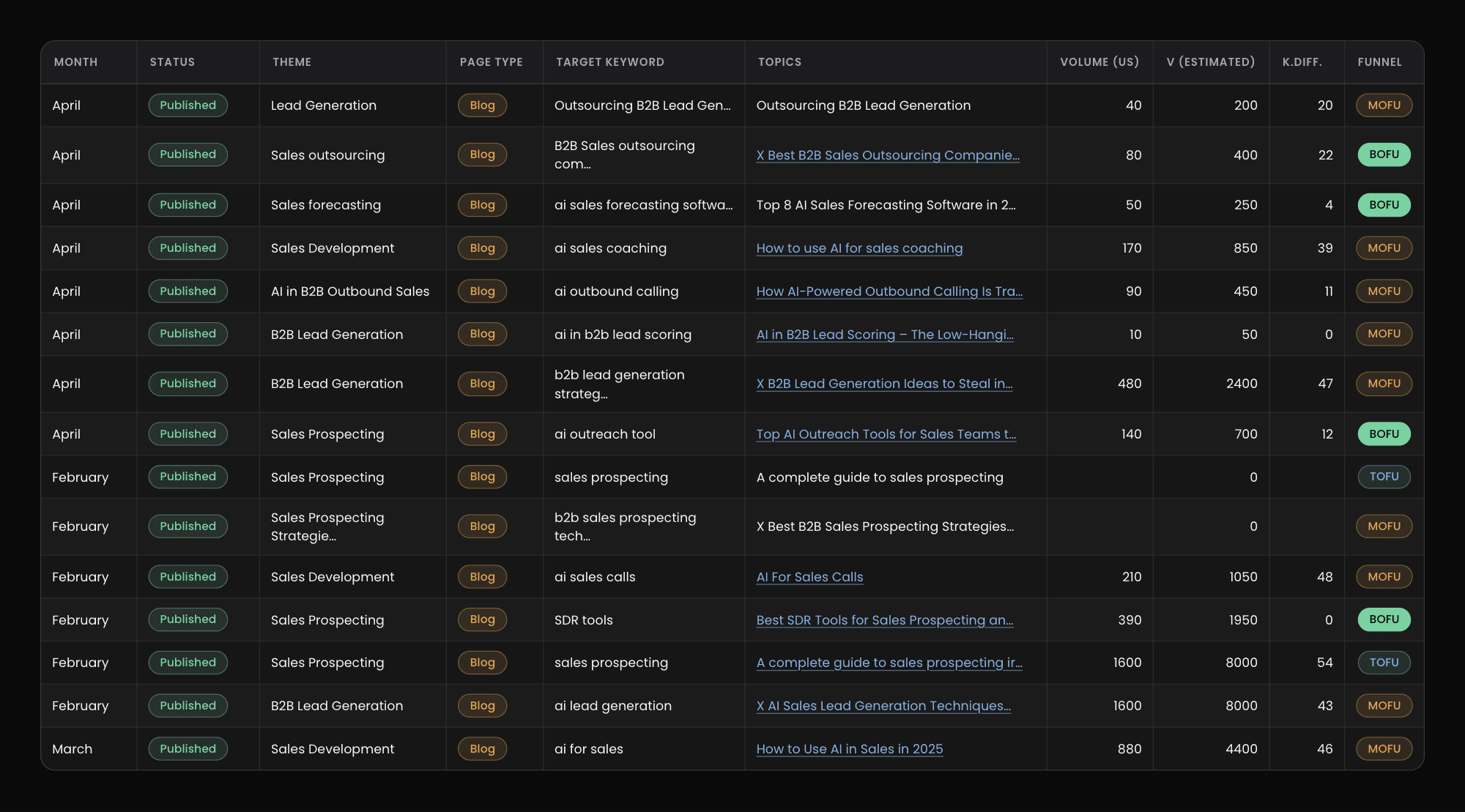
Content roadmap tracking theme, page type, target keyword, and funnel stage for every piece.
Step 4: Programmatic SEO (Controlled Expansion)
We scaled ColdIQ’s programmatic efforts through:
A structured tools and directory strategy
Careful keyword mapping to avoid cannibalization
Manual quality control to avoid low-value page expansion
This allowed ColdIQ to scale content without falling into the trap of mass low-quality pages.
Step 5: Backlinks & Brand Mentions Strategy
Instead of generic link building, we focused on strategic authority building:
Targeted backlinks aligned with high-value pages
Built brand mentions in contexts relevant to target keywords
Prioritized placements that influenced both Google rankings and LLM visibility
This led to consistent ranking improvements for priority keywords over time.
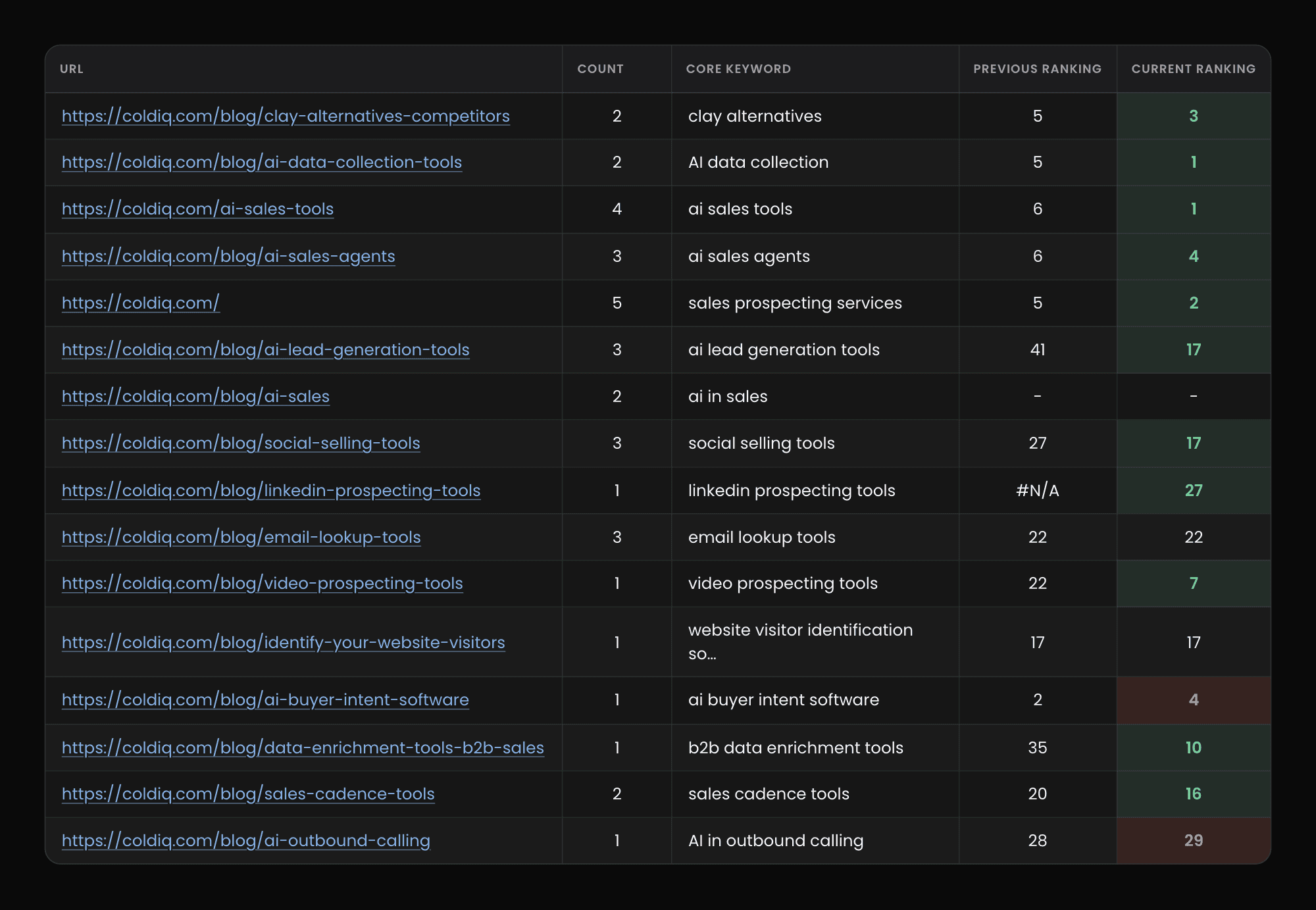
Priority keyword movement tracked against the pages and placements supporting them.
Step 6: AI Search Optimization (LLM Visibility Engine)
We treated AI search as a first-class acquisition channel:
Identified prompts and queries where ColdIQ lacked visibility
Built content and brand mentions aligned with those contexts
Used sales transcripts to generate realistic LLM prompts
Tracked visibility across platforms using prompt tracking tools
This resulted in a measurable increase in citations and referral traffic from AI platforms.
The Results: Compounding Growth Across Traffic, Conversions, and Revenue
Core Business Impact (within 13 Months)
Combined across strategic initiatives, new content, programmatic SEO, and site architecture improvements, the company achieved #1 rankings for highly competitive keywords, including “AI sales tools” and “sales prospecting services USA.”
The AI sales tool page began appearing in AI Overviews, while the company established strong topical authority across the sales category.
We also secured #1 rankings for highly competitive terms like “sales prospecting services USA” and many others, establishing strong topical authority across the sales category.
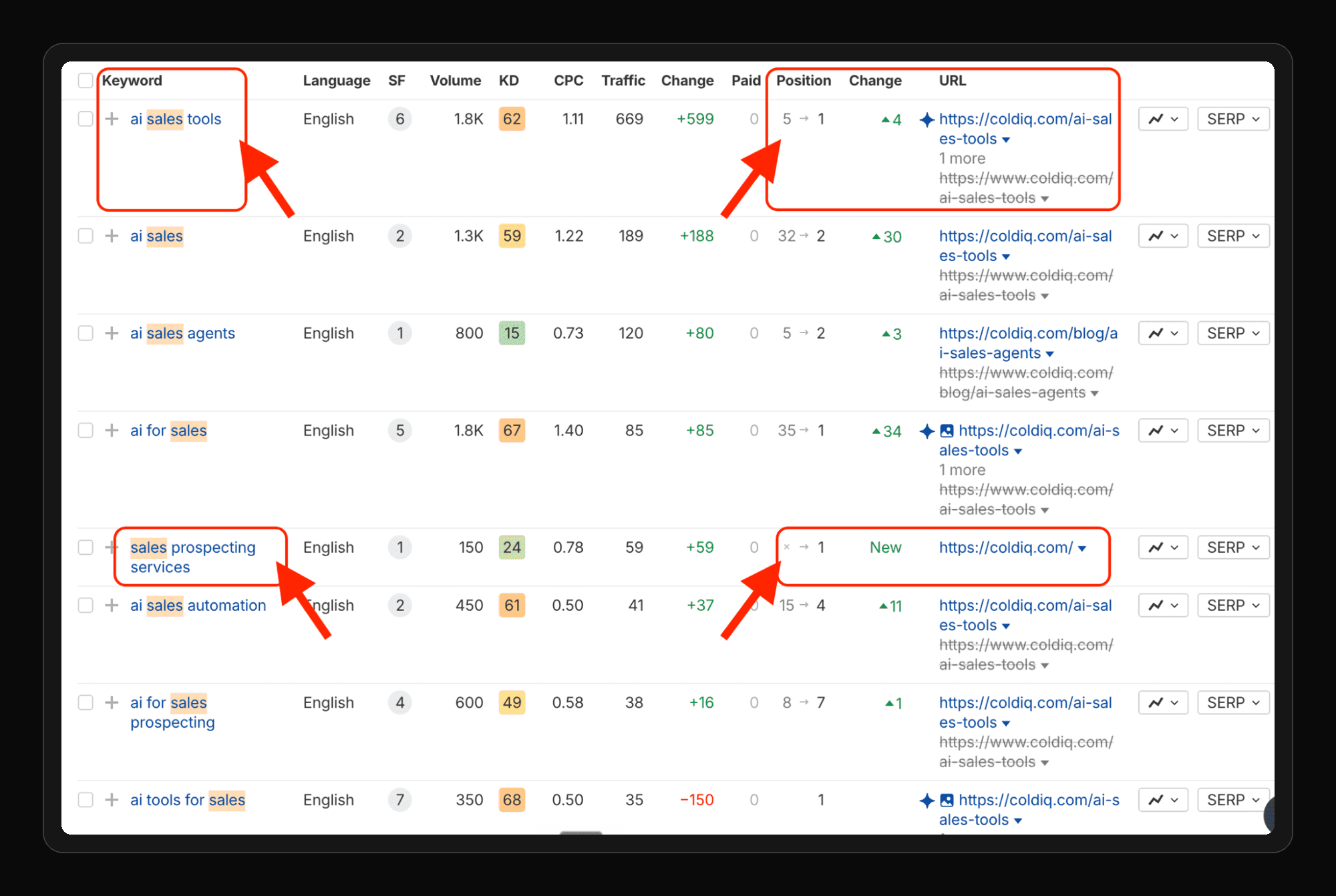
Position gains across core commercial keywords, including several moves into the #1 slot.
+49% growth in organic search traffic
Since we were primarily adding more qualified traffic than before, this resulted in disproportionately higher conversions.

Organic search sessions growth across the engagement.
+127% increase in agency form submissions
As we started bringing in more bottom-of-funnel traffic through commercial pages and intent-driven content, more visitors were landing on pages designed to convert, which led to a meaningful lift in form submissions.
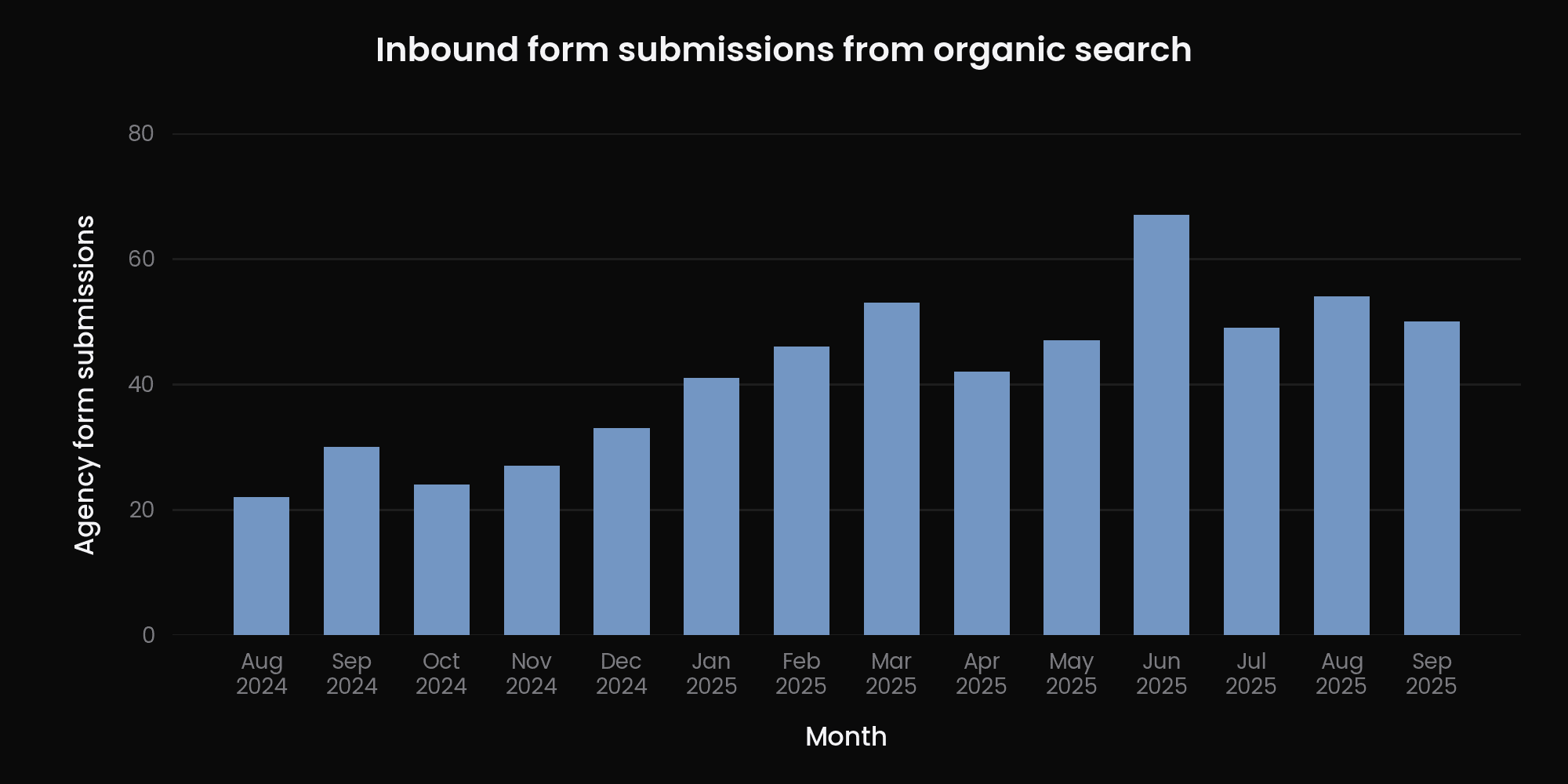
Inbound form submissions from organic search, month over month.
+162% increase in agency meetings booked
With better-qualified leads coming through organic search, the quality of conversations improved, which meant a higher percentage of those leads translated into actual booked meetings.

Inbound meetings booked from organic search, month over month.
CVR improved from 0.38% → 0.60% for form submissions and 0.14% → 0.25% for meetings booked
As content, positioning, and page structure became more aligned with what buyers were actively looking for, more of the existing traffic started converting instead of just browsing.
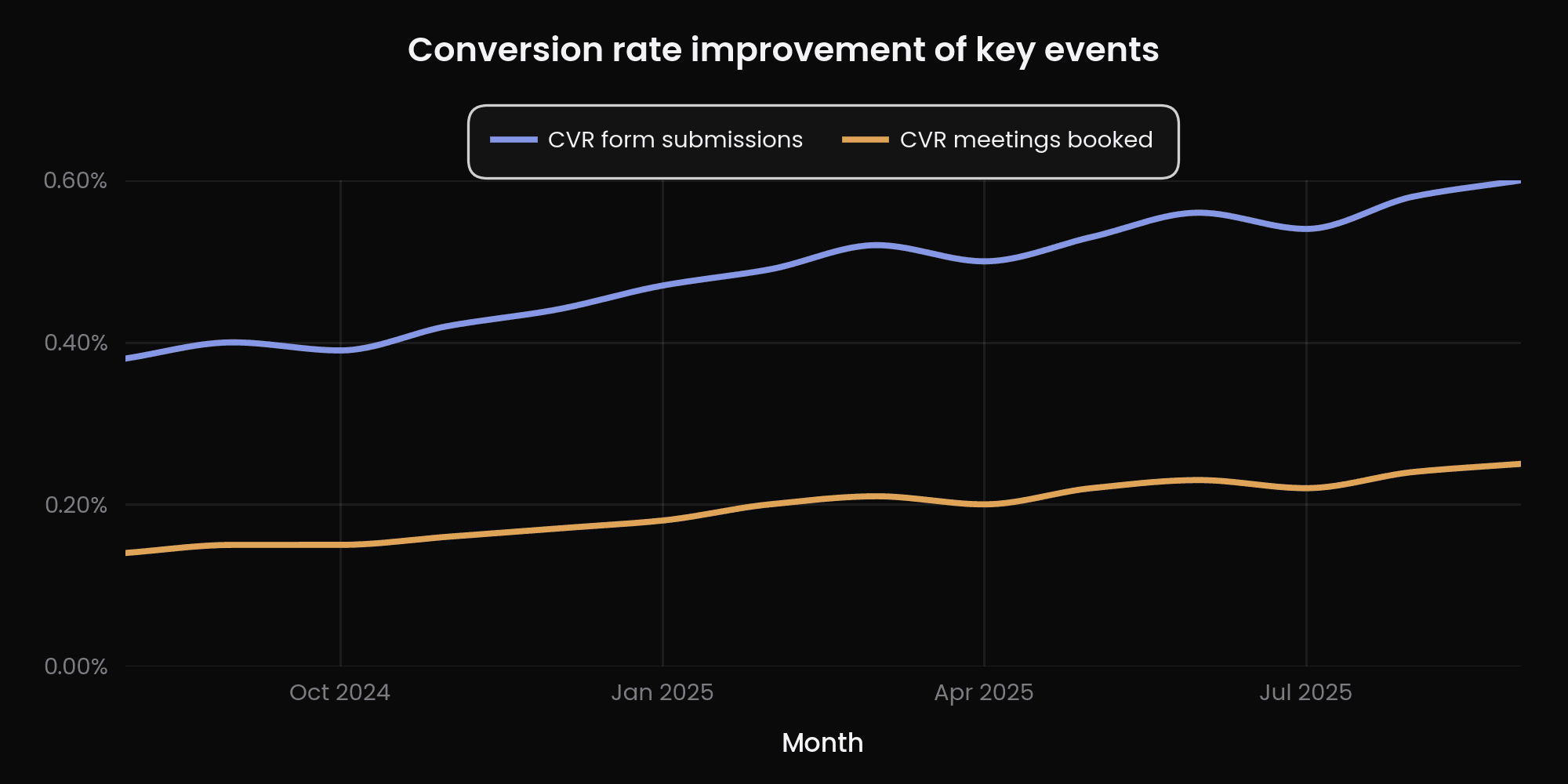
Conversion rate improvement across both key conversion events.
ARR scaled from $2.5M → $6.5M
While this growth wasn’t driven by organic search alone, the improvements in traffic quality and conversion rates from inbound contributed to a stronger pipeline, supporting overall revenue growth alongside other channels.
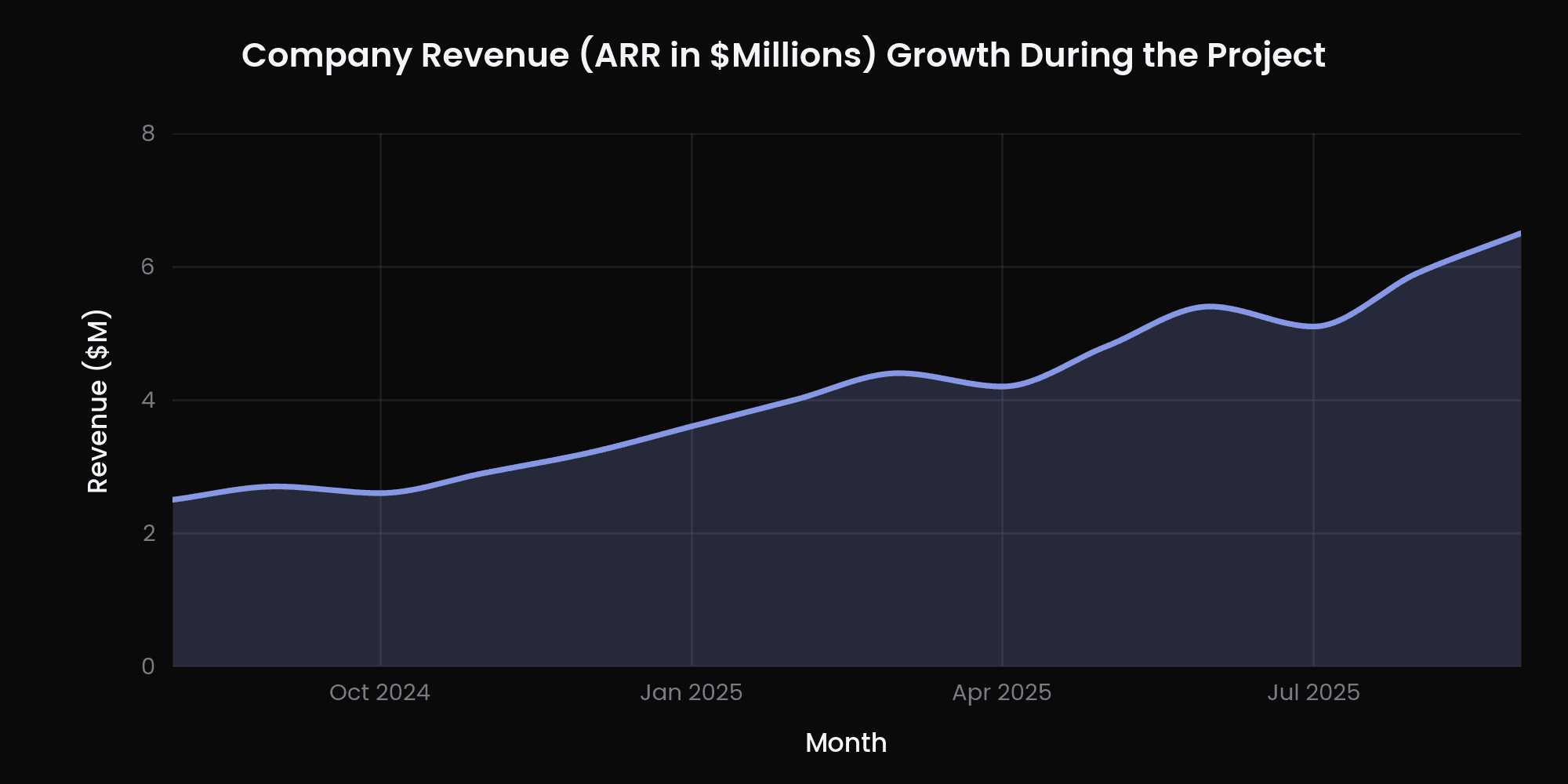
Company revenue (ARR, $M) across the project duration.
AI Search Growth
AI referral traffic increased by +169% over the project duration.
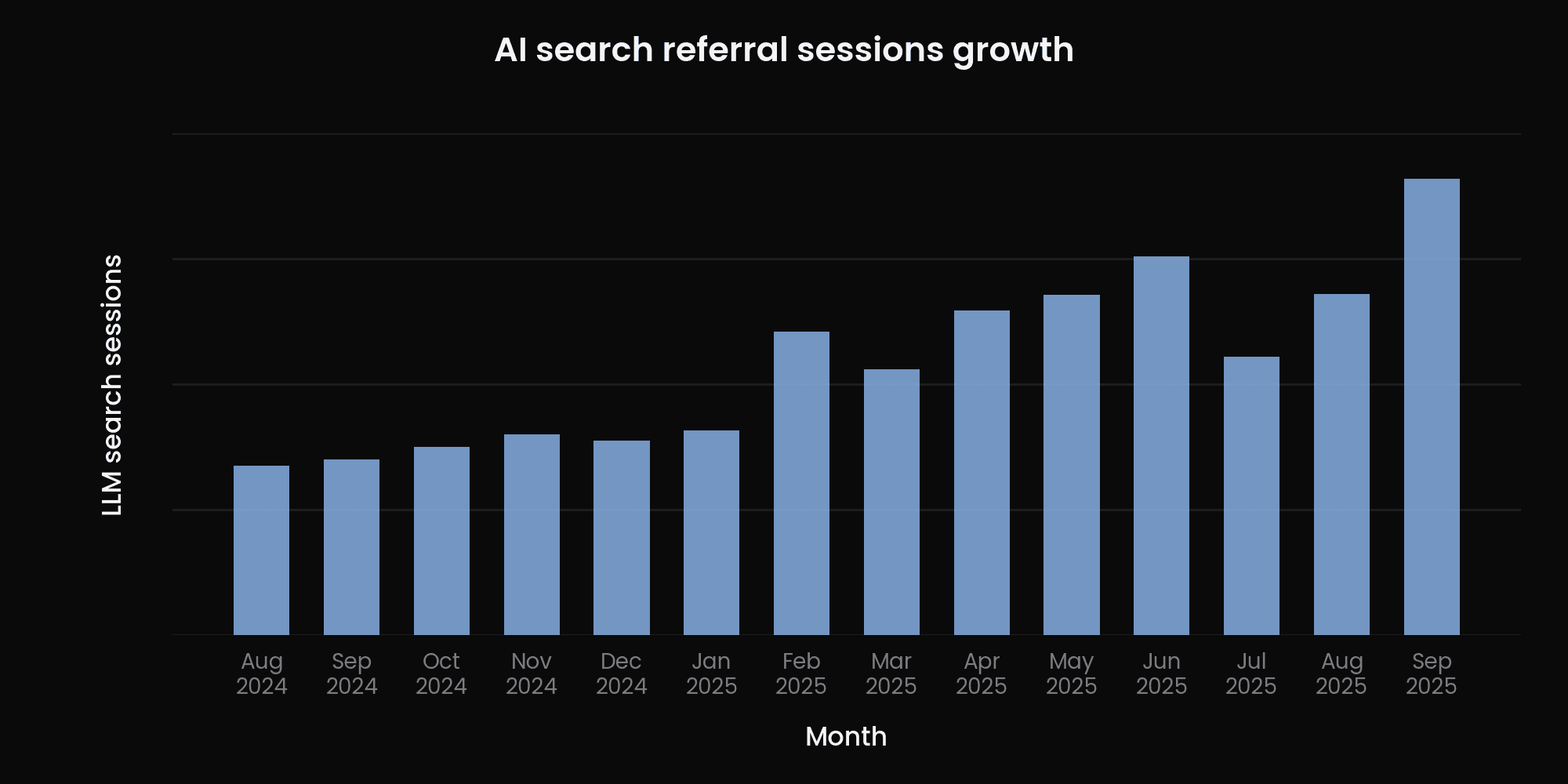
AI search referral sessions growth across the engagement.
LLM citation growth by platform:
Gemini — +177%
ChatGPT — +126%
Google AI Overview — +105%
Perplexity — +49%
Copilot — +38%
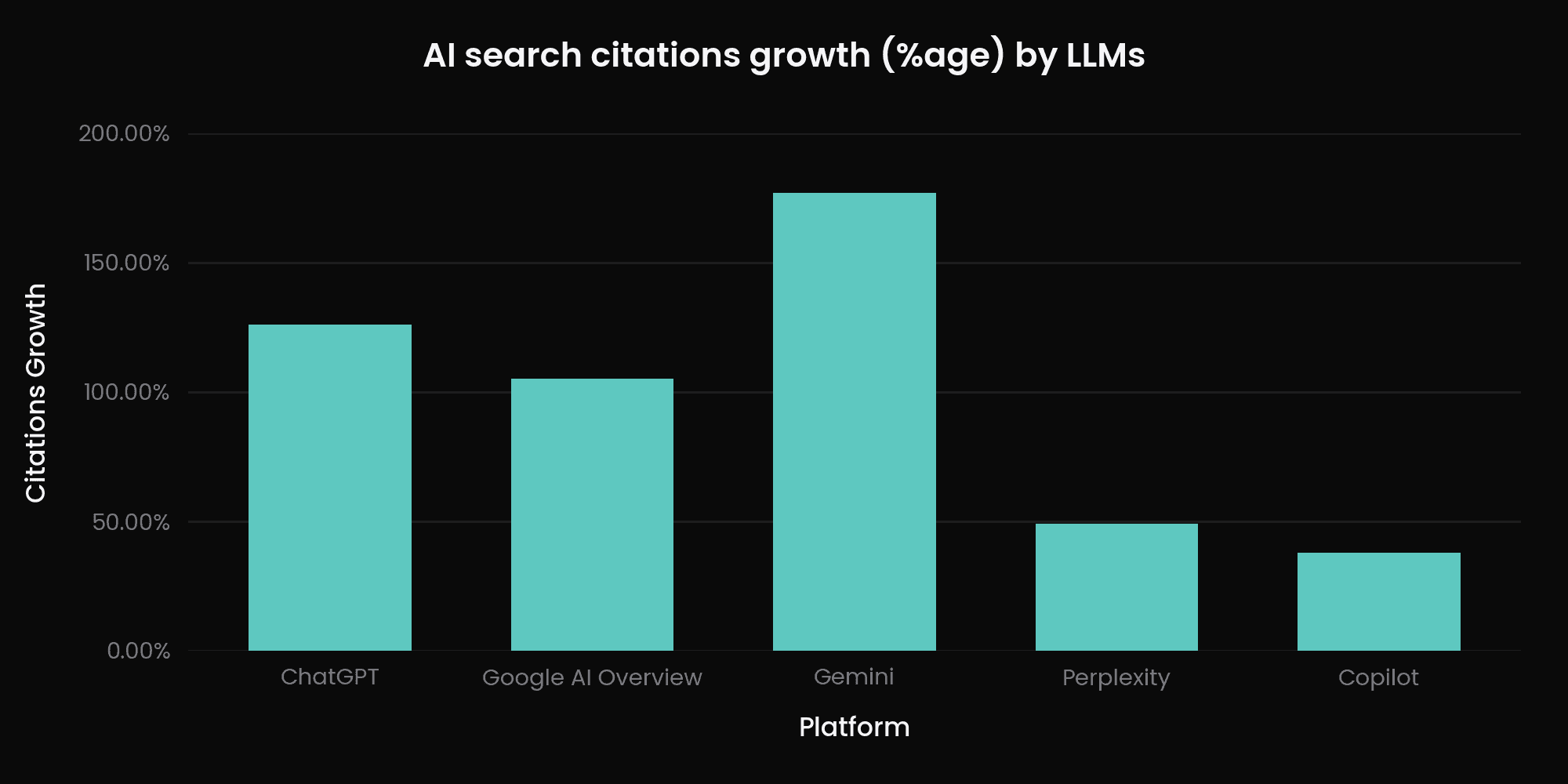
Citation growth by platform across AI search surfaces.
This reflects a significant increase in ColdIQ’s visibility across AI-powered discovery channels.
Compounding Impact Over Time
Early gains came from content optimization and internal linking
Mid-phase growth was driven by new content + programmatic expansion
Later-stage acceleration was fueled by:
AI search visibility
Brand authority
Conversion improvements
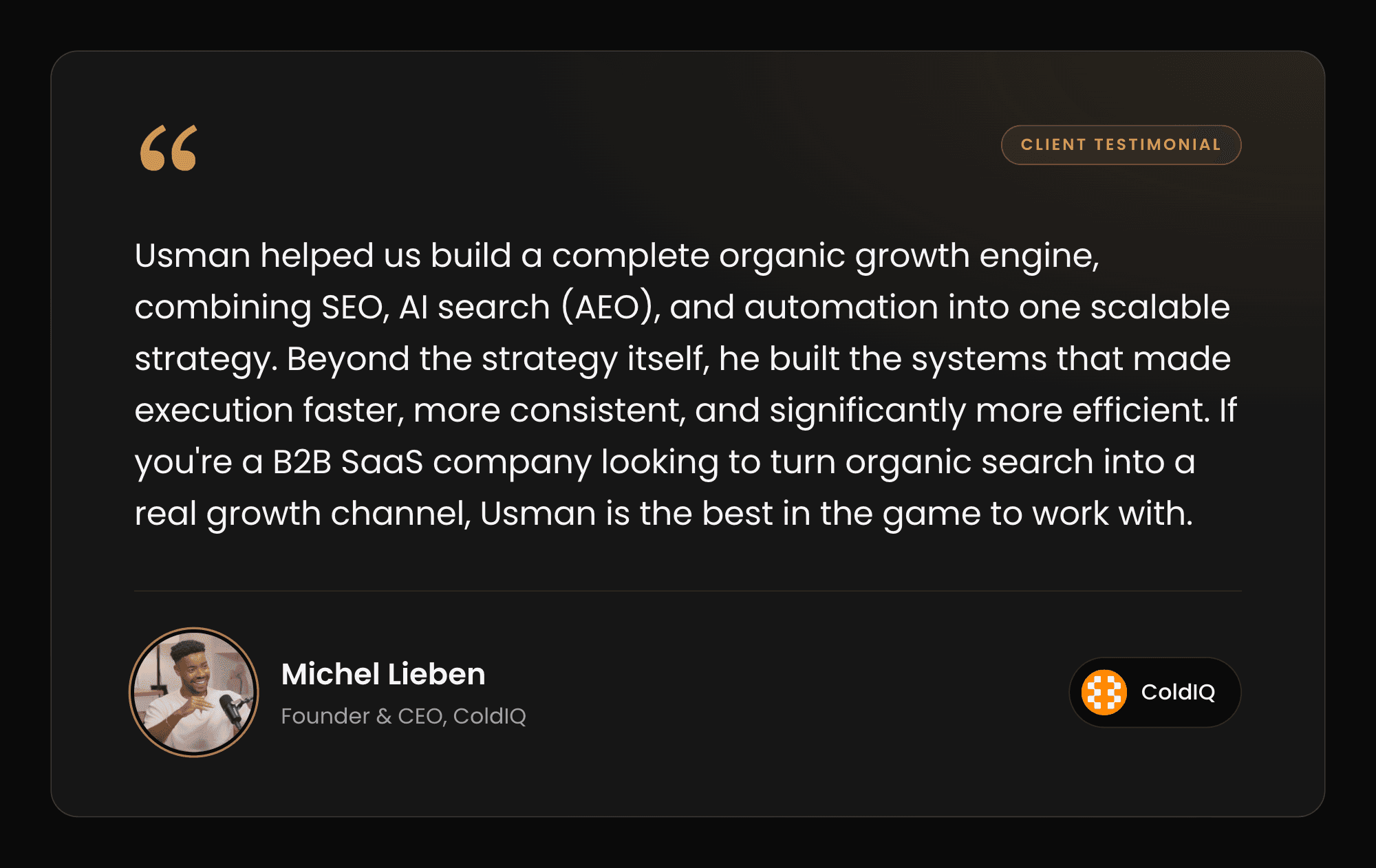
What ColdIQ said about the engagement
Here’s what Michel Lieben, Founder & CEO of ColdIQ, said about working together:
Conclusion: Building a Multi-Channel Organic Growth Engine
By combining traditional SEO with AI search optimization, ColdIQ successfully transitioned from a reliance on outbound and paid channels to a scalable inbound growth engine.
Key outcomes:
Built a predictable pipeline from organic search
Established early authority in AI-driven outbound categories
Created a system that compounds across:
Google rankings
AI search visibility
Conversion efficiency
ColdIQ now operates with a more resilient acquisition model, where organic growth not only drives traffic but consistently converts into qualified pipeline and revenue.