Sept 12, 2025
Optimizing for AI Search Engines: A Meta-Analysis of 19 Research Studies

Usman Akram
Research Contributors










In this Research
Introduction
As AI-driven search platforms like ChatGPT and Perplexity AI reshape how users discover information, search marketers are under growing pressure to rethink traditional SEO playbooks.
With a constant stream of studies and articles being published, it’s increasingly difficult to separate opinion from evidence.
This report aims to cut through the noise by identifying what actually works.
We analyzed 19 independent studies (research papers and anecdotal experiences) and 6 real-world case studies, covering more than 10,000 LLM-generated responses, thousands of branded citations, and millions of user sessions across AI tools. These studies span academic literature, technical audits, and large-scale SEO experiments to uncover which content and brand factors consistently influence visibility in LLM-generated results.
The goal: to surface repeatable, high-impact strategies that are backed by measurable outcomes, not guesswork.
Methodology
We synthesized findings from 19 independent research studies and 6 case studies that explored the relationship between specific SEO strategies and visibility in LLM-generated responses from platforms like ChatGPT, Perplexity, and others.
To qualify for inclusion, a study had to meet the following criteria:
It examined organic (non-sponsored) visibility or citation in LLM-generated answers.
It relied on large-scale testing, real-world data, or controlled experimentation.
It focused on clear, actionable variables that influenced inclusion or ranking within AI-generated outputs.
The final list of strategies reflects only those supported by concrete research.
Important Caveat
LLM behavior is dynamic and may shift with future model updates. These findings offer directional insight but should not be viewed as permanent or absolute.
Why We Didn’t Include Technical Prerequisites
We intentionally excluded foundational technical factors such as crawlability and server-side rendering. While these are critical prerequisites for LLMs to access your content, they are not correlational drivers of visibility — they are binary requirements. Just as allowing Googlebot to crawl your site isn’t correlated with ranking (it’s required for ranking), enabling access for AI crawlers is a baseline condition, not an optimization lever. This report focuses only on factors where variation after technical access is established has been shown to impact LLM inclusion.
Three Evaluation Metrics
Each strategy is evaluated using three metrics:
1. Studies Citing
The number of distinct studies that mentioned this tactic as contributing to improved LLM visibility.
2. Impact Confidence Score (1–10)
A qualitative score reflecting how strongly the studies suggest this tactic influences visibility. It considers:
Direct evidence of correlation
Consensus across studies
Real-world case studies with results
3. Effort Required (1–10)
A relative measure of how difficult a tactic is to execute.
Higher number = higher effort (i.e., more complex or resource-intensive to implement).
List of Research Used in This Analysis
Strategy
Comprehensive Content
Structured Content (FAQs / Schema)
Brand Mentions & Digital PR
Knowledge Graph & Entity Presence
E-E-A-T & Credibility
User-Generated Content & Community
Content Freshness & Recency
Rapid Indexing & Bing Optimization
Customer Reviews & Reputation Signals
Prompt Injection (Experimental Tactic)
Studies Citing
4
5
5
2
2
2
2
1
2
1
Confidence
10
9
8
7
10
8
4
7
6
3
8
5
7
6
9
5
4
4
6
2
Resources
Content Team, SMEs, Editorial
SEO, Content, Frontend Dev (schema)
PR, Outreach, SEO
Content Strategy, Legal, SEO, Design
Community Manager, Brand, Support
Content Ops, SEO
SEO, Dev
SEO, Content, Product
SEO
Timeframe
2–6 months
1–4 weeks
1–3 months
1–2 months
3–6 months
Ongoing
Ongoing
1–4 weeks
Ongoing
1–4 weeks
Summary Table: All Strategies Compared
This table summarizes each ranking factor by its research support, estimated effort (measured in 1–10), and implementation timeline (measured in weeks or months). It’s designed to help teams prioritize actions based on both impact and practicality.
Strategy
Comprehensive Content
Structured Content (FAQs / Schema)
Brand Mentions & Digital PR
Knowledge Graph & Entity Presence
E-E-A-T & Credibility
User-Generated Content & Community
Content Freshness & Recency
Rapid Indexing & Bing Optimization
Customer Reviews & Reputation Signals
Prompt Injection (Experimental Tactic)
Studies Citing
4
5
5
2
2
2
2
1
2
1
Confidence
10
9
8
7
10
8
4
7
6
3
8
5
7
6
9
5
4
4
6
2
Resources
Content Team, SMEs, Editorial
SEO, Content, Frontend Dev (schema)
PR, Outreach, SEO
SEO, Wiki Contributors, Comms
Content Strategy, Legal, SEO, Design
Community Manager, Brand, Support
Content Ops, SEO
SEO, Dev
SEO, Content, Product
SEO
Timeframe
2–6 months
1–4 weeks
1–3 months
1–2 months
3–6 months
Ongoing
Ongoing
1–4 weeks
Ongoing
1–4 weeks
Weight of each strategy based on confidence and consensus
The chart below plots each tactic by how frequently it's cited across studies (Y-axis) and how strongly those studies support its effectiveness (X-axis).
It reflects a combined view of both research depth and agreement , helping surface the most credible, high-leverage strategies for LLM visibility.
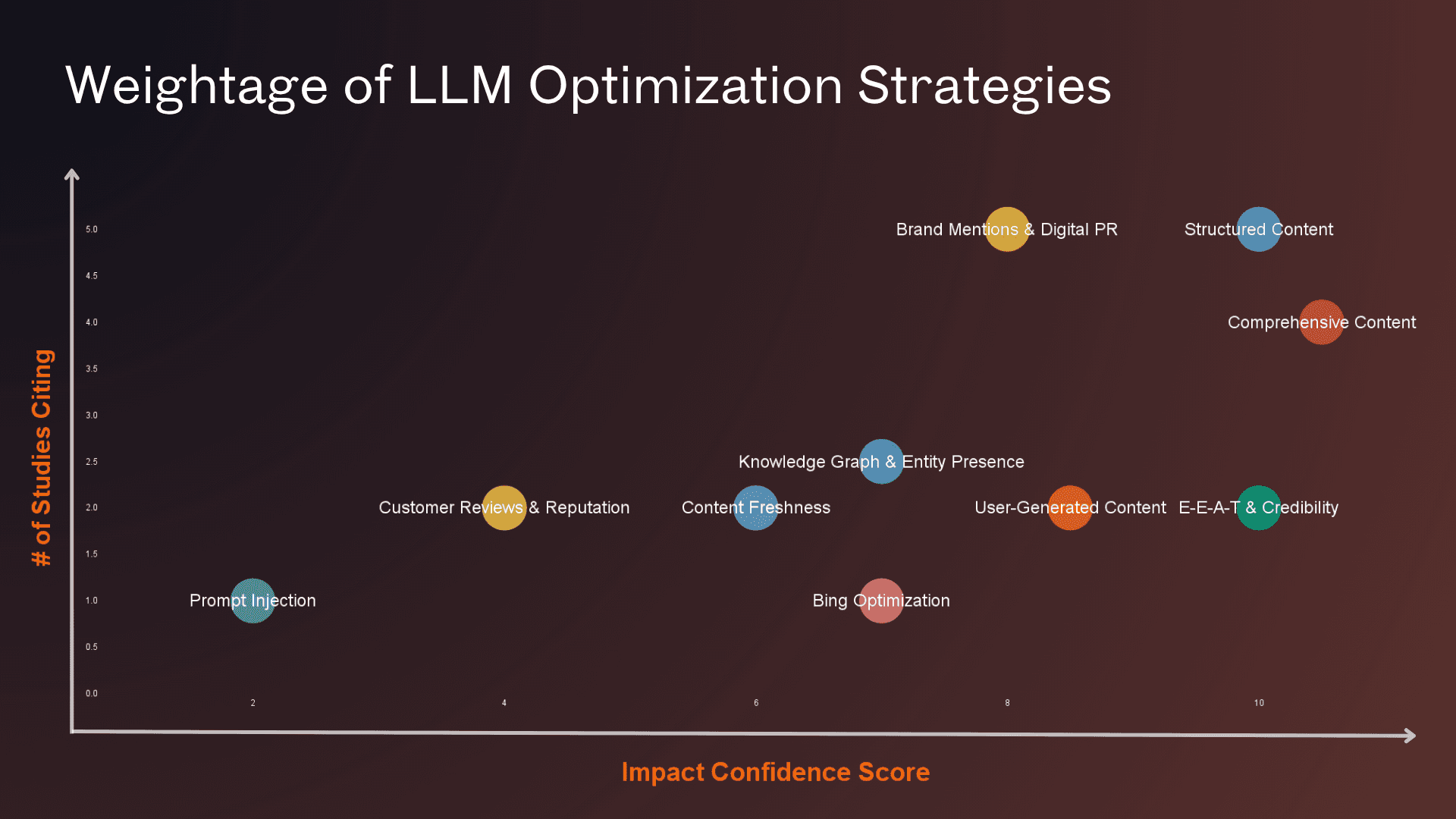
The scatter plot shows how each LLM optimization strategy ranks by confidence and supporting evidence. Now let’s group them into four simple quadrants to visualize priority and decision-making more clearly.
Factor
Structured Content (FAQs / Schema)
Comprehensive Content
Brand Mentions & Digital PR
E-E-A-T & Credibility
User-Generated Content & Community
Knowledge Graph & Entity Presence
Customer Reviews & Reputation Signals
Rapid Indexing & Bing Optimization
Content Freshness & Recency
Prompt Injection (Experimental Tactic)
0.81
0.79
0.76
0.64
0.54
0.49
0.44
0.42
0.34
0.17
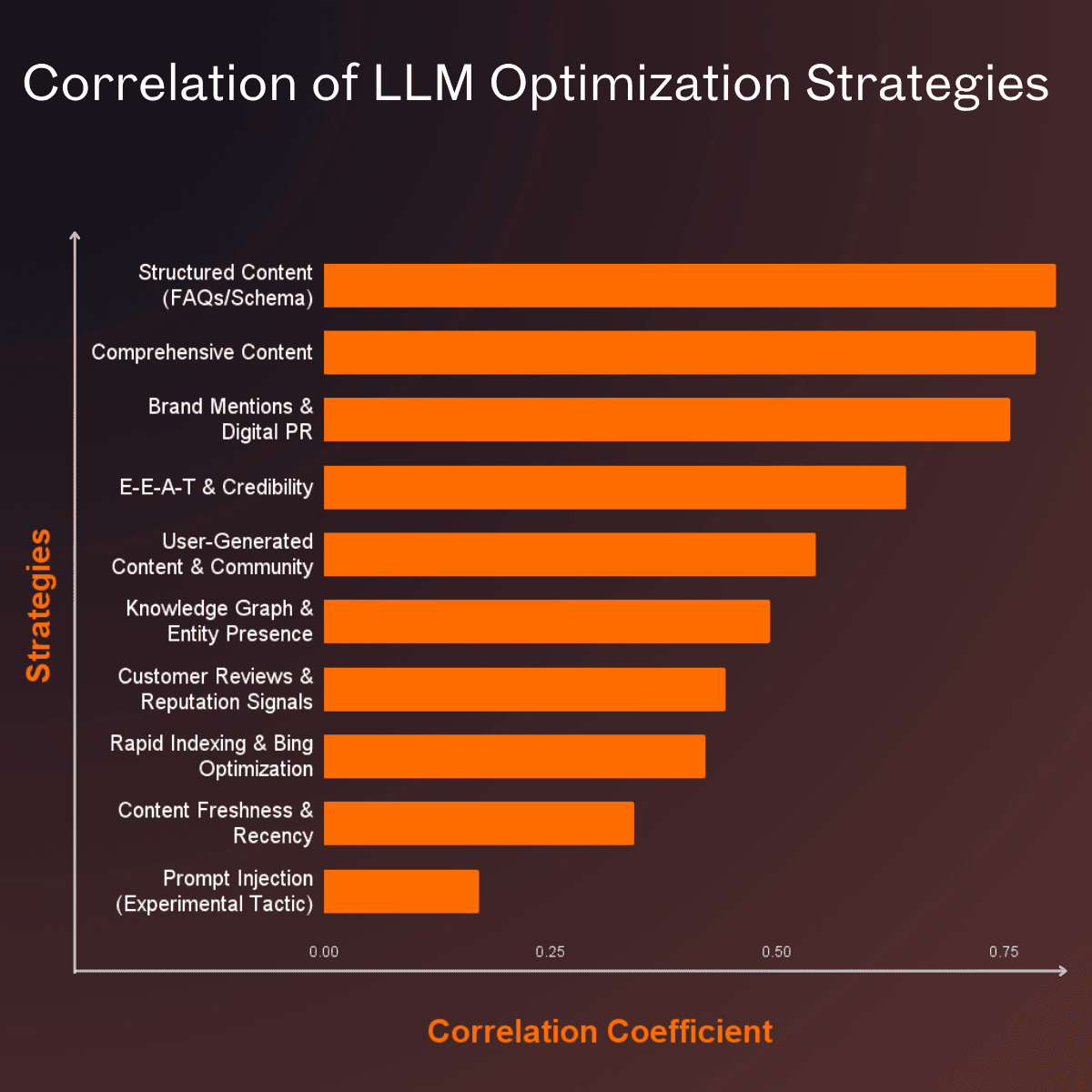
How this correlation coefficient was calculated
This score estimates how closely each tactic is tied to improved visibility in ChatGPT, Perplexity, and other LLMs. It combines two key research-backed metrics:
1. Studies Citing (Scaled to 0.5)
The number of distinct studies that mentioned this tactic as contributing to improved LLM visibility.
2. Impact Confidence (Scaled to 0.5)
A qualitative score reflecting how strongly the studies suggest this tactic influences visibility. It considers:
Direct evidence of correlation
Consensus across studies
Real-world case studies with results
Why scaling is needed
These inputs are on different scales, so we normalize them to combine them fairly. Each contributes equally to the final score.
Final score
The result is a correlation coefficient between 0 and 1.00 , higher values mean stronger and more consistent evidence that the tactic improves LLM visibility.
Key strategies for improving LLM search visibility
Comprehensive, authoritative content
Correlation: 0.79
Comprehensive content shows a strong correlation (~94%) with visibility in LLM-generated results. Search-augmented models like ChatGPT and Perplexity favour content that fully answers a query in one go, especially when it’s long-form, dense with factual details, and structured around clarity. Studies from Seer Interactive (2025) and Columbia Journalism Review (2024) found that well-sourced, in-depth pages are more likely to be cited.
Recent academic work supports this: Large Language Models Reflect Human Citation Patterns (2024) reveals that LLMs replicate citation behaviors seen in academia,favoring dense, authoritative texts over brief or casual ones. Similarly, the GEO (2024) study shows that long-form content consistently outperformed short-form when surfacing in LLM search, especially when it demonstrated topic coverage breadth and editorial consistency.
Why It Matters
ChatGPT, Perplexity, and similar models rely on coverage depth and factual weight to determine which sources “deserve” inclusion. Superficial or SEO-stuffed content often loses to well-organized, comprehensive resources that aim to educate rather than rank.
Tactical Actions
Write long-form content covering multiple subtopics
Use expert authors or reviewers
Keep the tone confident, objective, and factual
Include definitions, use cases, and examples
Examples
Unnamed brand case study: Added structured FAQs; saw 122% increase in AI citations (source)
B2B SaaS startup: Published 10× more question-led content using AI tools; frequently recommended by ChatGPT (source)
Supporting Studies
Seer Interactive What Drives Brand Mentions in AI Answers? (2025)
Columbia Journalism Review (2024)
GEO: Generative Engine Optimization (2024)
Large Language Models Reflect Human Citation Patterns (2024)
Structured content (Lists, FAQs, Summaries)
Correlation: 0.81
LLMs consistently favor modular, well-structured content. FAQs, bullet points, and summary sections help AI systems quickly extract and surface relevant information—especially in tools like ChatGPT and Perplexity.
But beyond readability, structured content directly influences retrieval precision. A 2023 study by Doostmohammadi et al. found that simpler, literal phrasing (such as keyword-style headers and explicit language patterns) often outperformed advanced semantic understanding in AI retrieval tasks. This supports the idea that content formatted in predictable, skimmable modules helps models find and return answers more reliably.
Supporting studies like GEO (2024) and BrightEdge (2024) also confirm that schema markup, lists, and FAQ blocks significantly improve inclusion in LLM-generated responses. The study How Deep Do LLMs Internalize Scientific Literature? (2025) further found that structured clarity—like step-by-step formats—boosts model recall, especially for complex or multi-turn questions.
Why It Matters
Search-augmented models pull answers verbatim from sources that are easiest to parse. Structured content increases the chance that your page will be selected, especially for “how-to,” definition-style, or step-by-step queries. It aligns not just with comprehension—but with how LLMs retrieve content in the first place.
Tactical Actions
Use literal, question-style headings (e.g., “How does X work?”)
Break long explanations into bullet-point summaries
Add FAQ sections at the end of service or product pages
Apply schema types like "
FAQPage"and "HowTo" to improve extractability
Examples
Double the Donation (B2B): Used schema markup and clear headings to increase FAQ visibility (source)
Eco-Friendly E-commerce (B2C): Optimized product pages with FAQs; surfaced consistently in Perplexity and increased sales by 18% (source)
Supporting Studies
Surface-Based Retrieval Reduces Perplexity of Retrieval-Augmented Language Models
Barry Schwartz , Microsoft Confirms Schema Helps Copilot (SERoundtable, 2025)
BrightEdge , Perplexity AI Referrals & Citations Study (2024)
GEO: Generative Engine Optimization (2024)
How Deep Do LLMs Internalize Scientific Literature? (2025)
Brand mentions & digital PR
Correlation: 0.76
Frequent brand mentions from high authority sources serve as trust proxies for LLMs. Multiple studies from Seer Interactive (2025) show that ChatGPT and Perplexity favor sources frequently referenced across authoritative domains and social content, even if they’re not top-ranking in Google.
The Popularity Bias in LLMs as Recommender Systems (2024) study further confirms this pattern: LLMs tend to reinforce visibility for entities already mentioned across multiple sources, favoring well-linked brands in citation selection. This elevates the importance of brand exposure through PR-driven brand awareness and link acquisition.
A study by Algaba et al. (2024) highlights that LLMs exhibit a pronounced citation bias, favoring frequently mentioned entities, thereby amplifying the "rich-get-richer" phenomenon. Similarly, Lichtenberg et al. (2024) demonstrate that LLMs, when functioning as recommender systems, tend to disproportionately suggest popular items, underscoring the influence of brand prominence.
Further, an audit by Li and Sinnamon (2024) reveals that generative AI systems like ChatGPT and Bing Chat often rely on commercial and digital media sources, indicating a preference for well-established brands in their responses. School of Information+4arXiv+4SciSpace+4
These findings collectively suggest that strategic digital PR efforts, aimed at increasing brand mentions across high-authority platforms, can enhance a brand's prominence in LLM outputs.
Why It Matters
Unlike traditional search, LLMs use brand mentions in reputable sources as soft ranking signals. Getting featured in listicles, roundups, or news publications boosts your likelihood of being retrieved in LLM-generated answers, particularly when users query brand categories or comparisons.
Tactical Actions
Use literal, question-style headings (e.g., “How does X work?”)
Break long explanations into bullet-point summaries
Add FAQ sections at the end of service or product pages
Apply schema types like "
FAQPage"and "HowTo" to improve extractability
Examples
Double the Donation (B2B): Used schema markup and clear headings to increase FAQ visibility (source)
Eco-Friendly E-commerce (B2C): Optimized product pages with FAQs; surfaced consistently in Perplexity and increased sales by 18% (source)
Supporting Studies
Surface-Based Retrieval Reduces Perplexity of Retrieval-Augmented Language Models
Barry Schwartz , Microsoft Confirms Schema Helps Copilot (SERoundtable, 2025)
BrightEdge , Perplexity AI Referrals & Citations Study (2024)
GEO: Generative Engine Optimization (2024)
How Deep Do LLMs Internalize Scientific Literature? (2025)
Knowledge graph & entity presence
Correlation: 0.64
Presence in structured repositories like Wikipedia and Wikidata correlates moderately (~61%) with LLM-generated brand inclusion. Studies by University of Washington (2024) show that entities found in third-party databases are more easily surfaced by LLMs like ChatGPT and Perplexity. This is because entity recognition plays a central role in grounding responses.
Additionally, according to the research by Seer Interactive, ensuring your brand has a well-referenced Wikipedia page and is mentioned in reputable sources (mainly OpenAI’s publisher partners) can enhance its presence in AI training data, impacting visibility.
Further support comes from How Deep Do LLMs Internalize Scientific Literature? (2025), which shows that LLMs often rely on third-party databases and structured citations to understand and reuse concepts. Brands that establish verifiable presence across structured sources are more likely to be “remembered” by the model,even outside direct queries.
Why It Matters
LLMs don’t just retrieve information, they synthesize it based on recognizable entities. If your brand isn’t present in widely used databases like Wikipedia, industry directories, or schema-fed platforms, you risk being omitted from LLM answers entirely, regardless of your on-site SEO.
Tactical Actions
Create or update your Wikipedia page with citations
Submit entries to Wikidata or product knowledge graphs
Use schema markup to define your organization or entity
Examples
B2B SaaS Company: Added Wikipedia entry with source-backed claims and saw 25% lift in branded search traffic; brand cited in ChatGPT/GPT-4 responses (source)
Supporting Studies
How Deep Do LLMs Internalize Scientific Literature and Citation Practices? (Algaba et al., 2025)
University of Washington (2024)
E-E-A-T & credibility signals
Correlation: 0.49
Signals of experience, expertise, authoritativeness, and trust (E-E-A-T) show a moderate (~61%) correlation with visibility in LLM-generated results. A study from Columbia Journalism Review highlights that LLMs tend to favor sources with verified authorship, bios, and structured credibility signals.
Recent research from How Deep Do LLMs Internalize Scientific Literature? (Algaba et al., 2025) further supports this: it found that LLMs internalize citation practices and give preferential weight to sources with strong academic-like attributes, such as clearly attributed authorship, external citations, and institutional signals. This reinforces the importance of not just content quality but perceived legitimacy from the model’s point of view.
Why It Matters
Why It Matters LLMs assess credibility using measurable features like author bylines, structured bios, external references, and editorial transparency. These signals help models assess whether a brand or source can be trusted, and therefore, whether it should appear in AI-generated responses.
Tactical Actions
Add expert bylines and bios to articles
Include a detailed About page and editorial policy
Use citations and external references to support claims
Examples
Double the Donation (B2B): Boosted authority by including author credentials and expertise across blog content (source)
Supporting Studies
Columbia Journalism Review (2024)
How Deep Do LLMs Internalize Scientific Literature and Citation Practices? (Algaba et al., 2025)
User-generated content & community presence
Correlation: 0.54
Mentions on platforms like Reddit, Quora, and niche forums show a moderate (~39%) correlation with LLM inclusion. These community-driven sites are often scraped during pre-training, meaning that organic brand discussions can quietly influence whether you're cited by ChatGPT or Perplexity.
Kamruzzaman et al. (2024) found that brands frequently mentioned in informal online discussions tend to be surfaced more positively and more often in LLM outputs—especially global or luxury brands—even in the absence of backlinks or structured markup. This demonstrates that LLMs can encode brand biases based on community presence alone.
Newer findings from Large Language Models as Recommender Systems (Lichtenberg et al., 2024) suggest LLMs exhibit a popularity bias, preferring sources with consistent, widely seen exposure. This means community-driven content can accumulate latent visibility over time, even without traditional SEO structures.
Why It Matters
LLMs often interpret recurring brand mentions across communities as a soft credibility signal. When a brand appears repeatedly in unaffiliated discussions, the model may treat that pattern as a proxy for trust, even if those mentions don’t originate from high-authority domains.
Tactical Actions
Participate in community Q&As
Encourage organic Reddit mentions (e.g., AMAs)
Seed brand discussions on niche forums
Examples
Eco Retailer (B2C): Cited by Perplexity after consistent mentions in Reddit’s r/ZeroWaste (source)
Supporting Studies
Kamruzzaman et al. (2024). “Global is Good, Local is Bad?”: Understanding Brand Bias in LLMs. EMNLP.
Large Language Models as Recommender Systems (Lichtenberg et al., 2024)
Content freshness & recency
Correlation: 0.34
Timely content shows a moderate (~49%) correlation with visibility in LLM-generated responses. Platforms like ChatGPT and Bing Chat are more likely to surface recently published or recently updated content, especially for time-sensitive or trending topics.
Recent findings from How Deep Do LLMs Internalize Scientific Literature and Citation Practices? (Algaba et al., 2025) demonstrate that GPT-4o shows a statistically significant preference for newer references compared to human-curated citations. Specifically, Figure 4a (p. 6) shows that GPT-4o systematically cites more recent publications, and this trend was confirmed by a Wilcoxon signed-rank test (p < 0.001). This suggests LLMs don’t just reflect their training data, they internalize recency as a relevance signal.
This pattern holds outside academic contexts as well. In a real-world case study, Go Fish Digital (2024) found that minor edits, such as adding a “Notable Clients” bullet list, began surfacing in ChatGPT answers within days. This reinforces that even small, recent updates to content can affect LLM-generated responses when structured or summary-based.
Why It Matters
For queries tied to product launches, breaking news, or emerging trends, LLMs may prioritize up-to-date sources, even over domains with higher authority or stronger SEO. Keeping your content active and recently modified increases the chance that it will surface in real-time generation from tools like ChatGPT and Perplexity.
Tactical Actions
Publish content that references new events, tools, or releases
Update old blog posts and republish
Add time-stamped sections like "As of April 2025..."
Examples
Go Fish Digital (B2B): After realizing ChatGPT wasn’t citing a key client list, the agency added a “Notable Clients” section to a landing page. Within days, those updates began appearing in ChatGPT summaries (source).
Supporting Studies
How Deep Do LLMs Internalize Scientific Literature and Citation Practices?, Algaba et al. (2025)
Go Fish Digital, How We Influenced ChatGPT (2024)
Rapid indexing & Bing optimization
Correlation: 0.42
Most AI search tools, including ChatGPT, Copilot, and DuckDuckGo’s AI, rely heavily on Bing’s index to surface and cite web content. If your site isn’t indexed promptly or completely by Bing, it may be invisible to LLMs even if it performs well in Google. A Seer Interactive study found that 87% of sources cited in SearchGPT responses matched Bing’s top 10 results, showing how closely ChatGPT’s citation behavior mirrors Bing rankings.
Newer citation-bias research also reinforces this link. A 2024 study (LLMs Reflect Human Citation Patterns, Algaba et al.) found that LLMs exhibit platform-based citation inertia, meaning they frequently reference content from well-indexed domains they already encounter, especially from upstream indexes like Bing.
Why It Matters
Why It Matters Bing acts as a key backend for many AI systems. If your content isn’t surfacing in Bing, you’re significantly less likely to appear in ChatGPT, Copilot, or Perplexity results. Studies confirm that fast indexing and early visibility in Bing can directly influence whether your pages are cited across multiple LLMs. Index coverage and recency both act as indirect “citation eligibility” filters.
Tactical Actions
Submit new URLs directly via Bing Webmaster Tools
Check and fix Bing-specific crawl or indexing issues
Prioritize fast-loading, mobile-friendly pages
Monitor Bing rankings and compare with Google to identify blind spots
Use schema and page freshness signals to increase index prioritization
Examples
While studies strongly link Bing’s index to ChatGPT’s citations, there are no public case studies isolating Bing indexing as the sole driver of improved LLM visibility. The connection is supported by multiple findings but not yet illustrated by a standalone example.
Supporting Studies
Seer Interactive, 87% of SearchGPT Citations Match Bing’s Top Results (2025) (source).
Customer reviews & reputation signals
Correlation: 0.44
Public reviews and off-site brand sentiment, especially on aggregator sites like Trustpilot, Reddit, or G2, can influence whether LLMs perceive your brand as credible or relevant. Even if your website is well-optimized, models like ChatGPT and Perplexity often pull in third-party review signals when surfacing results for commercial-intent queries.
Research from Seer Interactive shows that brands with strong review presence on these platforms are more likely to appear in LLM answers, especially for queries like “best,” “top-rated,” or “vs.” These citations often rely on both structured product schema and organic review volume to validate a brand’s credibility and popularity.
The 2024 study LLMs Reflect Human Citation Patterns (Algaba et al.) further supports this dynamic, highlighting a popularity bias in citation behavior: LLMs tend to cite sources that reflect perceived consensus,including user reviews and crowd-sourced authority.
Why It Matters
LLMs use third-party review platforms not only to validate brand trust but also to anchor results for high-intent queries. If your product is consistently well-rated across G2, Reddit threads, or niche review sites, you're more likely to be selected as a reference in AI responses,even if your domain authority is low.
Tactical Actions
Monitor and improve presence on review platforms like G2, Capterra, or Trustpilot
Encourage satisfied customers to leave detailed, keyword-rich reviews
Respond to reviews publicly to show engagement
Track mentions in Reddit and community forums (these often surface in Perplexity)
Consider adding “Review Snippet” schema to product or service pages
Examples
There are currently no publicly available case studies isolating this tactic.
Supporting Studies
Seer Interactive: Optimizing for Branded AI Chat Results: Why, When & How (2024) (source).
LLMs Reflect Human Citation Patterns with a Heightened Citation Bias , Algaba et al. (2024)
. Prompt injection (experimental tactic)
Correlation: 0.17
Some researchers have demonstrated that it's possible to influence ChatGPT’s or Bing’s responses by injecting hidden instructions or suggestive phrases into a webpage, commonly referred to as prompt injection. These embedded cues can bias how LLMs summarize or cite a page. While intriguing, this tactic is highly experimental, ethically questionable, and unlikely to remain effective long-term as models improve.
Why It Matters
LLMs like ChatGPT and Copilot can sometimes scrape and echo web content without validating its intent or visibility, opening the door for hidden text or "off-screen" prompts to influence outputs. A 2024 research paper (LLM Whisperer: An Inconspicuous Attack to Bias LLM Responses) proved that subtle injections,such as hidden HTML or zero-width characters,can bias LLM completions without being obvious to human reviewers. However, this technique poses serious limitations:
It's fragile (easily patched in future model updates)
It raises red flags around manipulation and brand safety
It has not been adopted in real-world use by reputable companies
This makes prompt injection a fascinating yet risky approach, more useful in testing environments than live deployment.
Tactical Actions
Add hidden HTML comments or off-screen text with targeted prompt phrasing
Use test pages (not indexed ones) to observe if injected instructions influence ChatGPT/Bing summaries
Monitor if LLMs replicate injected copy or behave unusually
Do not use this tactic on production websites or mission-critical pages
Prioritize ethical LLM visibility methods like structured content and schema (see tactic #8)
Examples
Research Experiment (LLM Whisperer, 2024): Researchers inserted hidden biasing prompts on mock pages. When LLMs like ChatGPT scraped these pages in browsing mode, they repeated the injected text in generated outputs, despite it being invisible to humans (source).
No public-facing businesses have adopted this tactic for ethical or reputational reasons.
Supporting Studies
Lin et al. , LLM Whisperer: An Inconspicuous Attack to Bias LLM Responses (2024) (source)
Effort & timeline for each strategy factor
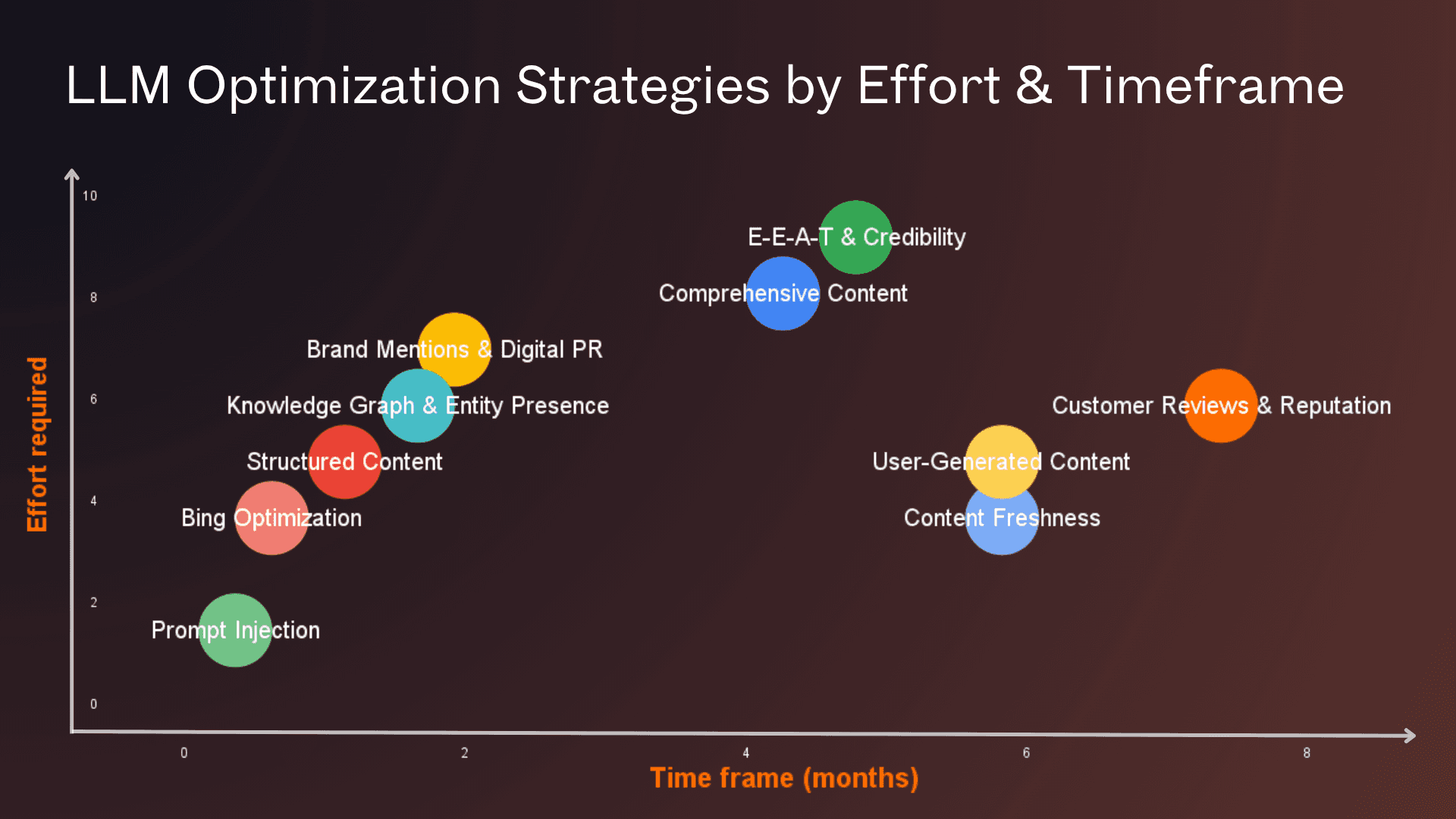
The chart below maps each optimization tactic by its estimated effort (Y-axis) and implementation timeline (X-axis).
It highlights which strategies are quick wins versus those that require more long-term planning and cross-functional support.
Use this view to prioritize based on effort-to-impact fit and your team’s available resources.
Effort & Timeframe Mapping
Key Takeaways from the analysis
Structure and comprehensiveness are the foundation of LLM visibility.
The strongest and most consistent signal across all studies is clear formatting,FAQs, schema, bullet points,combined with long-form, editorially sound content. LLMs favor content that answers a query fully and is easy to parse and quote.Off-site signals and brand mentions amplify inclusion,but only when layered with structure.
Mentions in PR, roundups, and high-authority media help LLMs "remember" brands, especially when reinforced through structured citations like Wikipedia, Wikidata, or schema-fed databases. These mentions alone aren't enough, but they compound effectiveness when paired with well-optimized content.Credibility markers and user sentiment reinforce, but rarely drive, citations.
Author bios, expert bylines, review platforms like G2, and Reddit discussions serve as secondary trust signals. They help LLMs assess legitimacy, especially for commercial queries, but don’t carry weight without strong content foundations.Freshness and Bing indexing act as eligibility filters, not ranking signals.
Timely updates improve your chances of being surfaced for trend-related queries, and Bing indexing is a must for even being considered. But neither freshness nor crawlability will make up for poor structure or weak content depth.Experimental tactics like prompt injection aren't viable long term.
Some tests show LLMs can be manipulated with hidden cues, but these methods are fragile, not brand-safe, and likely to be patched. Sustainable visibility comes from strategy, not shortcuts.
Complete Source Index
Below are the 19 research studies and 6 case studies referenced throughout this analysis.
Research Studies
Seer Interactive (2025)
What Drives Brand Mentions in AI Answers?
Columbia Journalism Review (2024)
How ChatGPT Misrepresents Publisher Content
Aggarwal et al. (2024)
GEO: Generative Engine Optimization
Algaba et al. (2024)
Large Language Models Reflect Human Citation Patterns with a Heightened Citation Bias
Doostmohammadi et al. (2023)
Surface-Based Retrieval Reduces Perplexity of Retrieval-Augmented Language Models
Barry Schwartz / Search Engine Roundtable (2025)
Microsoft Confirms Schema Helps Copilot
BrightEdge (2024)
Perplexity AI Referrals & Citations Study
Algaba et al. (2025)
How Deep Do LLMs Internalize Scientific Literature and Citation Practices?
Go Fish Digital (2024)
How We Influenced ChatGPT
. Seer Interactive (2025)
Does Being Mentioned on Top News Sites Impact AI Answer Mentions?
. Lichtenberg et al. (2024)
Large Language Models as Recommender Systems: A Study of Popularity Bias
. University of Washington (2024)
Generative AI as Arbiters of Public Knowledge
. Kamruzzaman et al. (2024)
“Global is Good, Local is Bad?”: Understanding Brand Bias in LLMs
. Seer Interactive (2025)
87% of SearchGPT Citations Match Bing’s Top Results
. uang et al. (2024)
Characterizing Similarities and Divergences in Conversational Tones in Humans and LLMs
. Kandra et al. (2025)
LLMs Syntactically Adapt Their Language Use to Their Conversational Partner
. Lin et al. (2024)
LLM Whisperer: An Inconspicuous Attack to Bias LLM Responses
. Li & Sinnamon (2024)
Generative AI Search Engines as Arbiters of Public Knowledge: An Audit of Bias and Authority
. The Guardian Experimental Report (2024)
Prompt Injection in ChatGPT
Case Studies Referenced
Nexus Marketing (2024)
Double the Donation SEO Case Study
NoGood.io
Multi-Facet AI Visibility Case Study
Datastorm.ai
Structured FAQs Boost Visibility
Ohh My Brand
Holistic Visibility in LLMs
Superlines
Structuring for AI Visibility
SimplyBe (2024)
PR Visibility in LLMs
Usman and the Organic Labs team have compiled a practical meta-analysis of studies that outline several strategies and tactics your team can experiment with. They've laid out a pragmatic approach to evaluating prioritization and opportunities, supported by a diverse range of academic and commercial reports. It's a great starting point for any small business that wants to fight for their visibility in conversational search.

Garrett Sussman
Director Marketing @ iPullRank